
Jerusalem(jebus, salem)
“Possession of peace or foundation of peace”
Summary
The ancient capital of Israel and Judah, situated in the Judean highlands, which served as the center of Jewish religious worship and became the setting for many of the most significant events in biblical history including the ministry, death, and resurrection of Jesus Christ.
☩Names and Etymology
The city has been known by various names throughout its history. The earliest known form, appearing in the Tell el-Amarna tablets (c. 1450 BC), is Uru-sa-lim. The Hebrew name יְרוּשָׁלַיִם (Yerushalayim) is a dual form, probably signifying "possession of peace" or "foundation of peace," with the dual possibly referring to the two chief mountains (Zion and Moriah) on which it was built. Other ancient names include Salem (שָׁלֵם), its poetic designation in Psalm 76:2 and possibly in Genesis 14:18 where Melchizedek reigned. It was originally called Jebus after its Canaanite inhabitants, the Jebusites. The city is also called Ariel ("lion of God") in Isaiah 29:1, and "the holy city" in Nehemiah 11:1 and Matthew 4:5. In the New Testament, two Greek forms appear: Ἱερουσαλήμ (Hierousalem), the more Hebraic form favored by Luke and Paul, and Ἱεροσόλυμα (Hierosolyma), the Hellenized form used by Josephus and in secular writings.
☩Geography and Topography
Jerusalem stands at latitude 31°46'35" north and longitude 35°18'30" east, approximately 32 miles from the Mediterranean Sea and 18 miles from the Jordan River. The city sits on a promontory of the Judean highlands, about 2,500 feet above sea level, with the descent to Jericho and the Dead Sea being extraordinarily steep—over 3,600 feet in just 13 miles. The site is naturally fortified on three sides by deep ravines: the Kidron Valley (Valley of Jehoshaphat) on the east, and the Valley of Hinnom (Gehenna) on the west and south, which meet at the city's southeast corner. The promontory itself is divided by the Tyropoeon Valley running north to south, creating two main hills: the higher western hill (later called Zion) and the lower eastern ridge (Mount Moriah) where the Temple stood. The surrounding mountains—the Mount of Olives to the east, and the hills of Bethlehem to the south—form a natural amphitheater around the city.
☩Early History
Jerusalem first appears in Scripture as Salem, where Melchizedek served as both king and priest when he blessed Abraham (c. 2080 BC). The mountain of Moriah, where Abraham was prepared to offer Isaac, is traditionally identified with the site where Solomon later built the Temple. The city is explicitly named in Joshua 10:1, where Adoni-zedek, king of Jerusalem, formed a coalition against Joshua. Though the territory was assigned to Benjamin, the Jebusites maintained their stronghold there for centuries. Judah captured and burned the city after Joshua's death (Judges 1:8), but the Jebusites retained possession of the fortress on Mount Zion until David's conquest.
☩David and Solomon
David's capture of the Jebusite stronghold (c. 1004 BC) transformed Jerusalem into the capital of the united monarchy. Joab led the assault that took the citadel, which David renamed "the City of David." David brought the Ark of the Covenant to Jerusalem and purchased the threshing floor of Araunah the Jebusite, the future site of the Temple. Though David desired to build a house for God, this privilege was reserved for his son Solomon, who constructed the magnificent Temple and greatly expanded and fortified the city. The Temple made Jerusalem the religious center of Israel, the place God chose for His name to dwell, where all Israelite males were required to appear three times annually for the major festivals.
☩Destruction and Restoration
After the kingdom divided, Jerusalem remained the capital of Judah and experienced numerous invasions: by Shishak of Egypt (c. 925 BC), Jehoash of Israel, and ultimately Nebuchadnezzar of Babylon. In 586 BC, Nebuchadnezzar destroyed both the city and Temple, deporting the population to Babylon. Following Cyrus's decree in 538 BC, exiles returned to rebuild the Temple (completed 516 BC). Nehemiah later rebuilt the city walls (445 BC) under Artaxerxes' authorization. The city subsequently came under Greek and then Roman rule, with Herod the Great undertaking massive building projects including the expansion of the Temple Mount.
☩Jerusalem in the New Testament
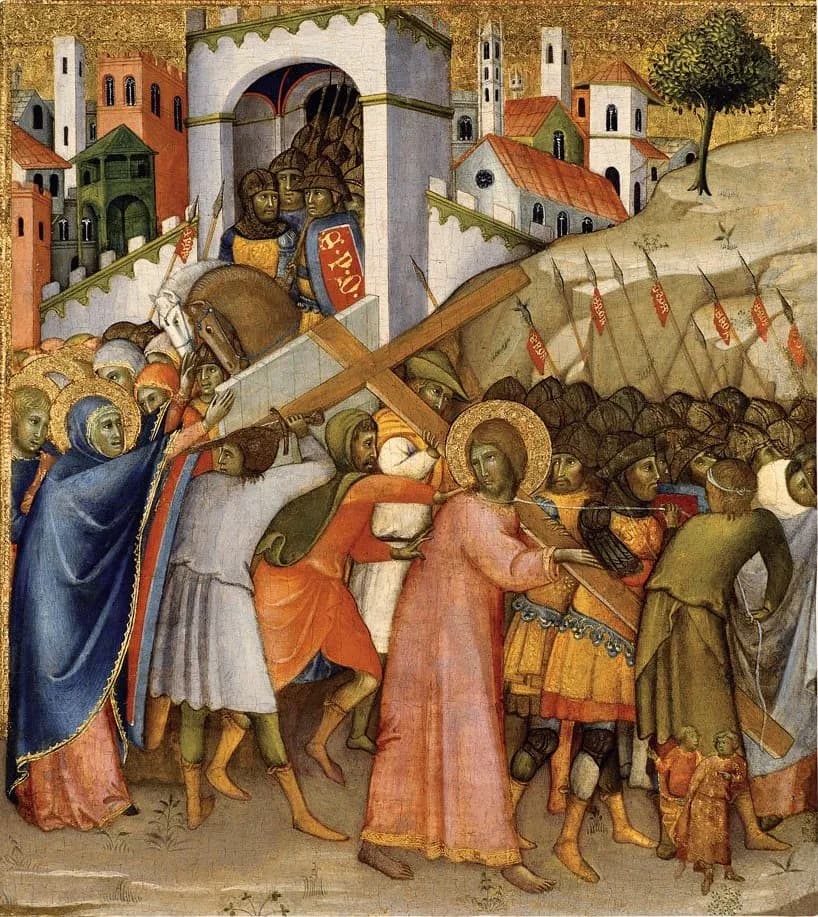
Jerusalem was the setting for pivotal events in Jesus' life: His presentation at the Temple as an infant, His teaching among the doctors at age twelve, His triumphal entry, His cleansing of the Temple, the Last Supper, His arrest in Gethsemane, trial, crucifixion at Calvary, and resurrection. Jesus wept over the city, prophesying its destruction (Luke 19:41-44). After His ascension from the Mount of Olives, the disciples gathered in Jerusalem where the Holy Spirit descended at Pentecost, marking the birth of the Church. The city remained the center of early Christianity until persecution scattered believers and the Roman destruction in AD 70 fulfilled Christ's prophecy. The city has endured approximately thirty sieges throughout its history.
Related Verses859 mentions
See Also

References
- 1.John McClintock and James Strong, "Jerusalem," in Cyclopedia of Biblical, Theological and Ecclesiastical Literature, vol. IV (Harper & Brothers, 1867–1887).
- 2.James Orr (ed.), "Jerusalem," in International Standard Bible Encyclopedia, vol. III (Howard-Severance Company, 1915).
- 3.George Morrish, "Jerusalem," in Morrish's Concise Bible Dictionary (George Morrish, 1898).
- 4.James Hastings (ed.), "Jerusalem," in Dictionary of the Apostolic Church, vol. I (T. & T. Clark, 1915–1918).
- 5.F. N. Peloubet & M. A. Peloubet (ed.), "Jerusalem," in Smith's Bible Dictionary (Porter & Coates, 1884).
- 6.Andrew Robert Fausset, "Jerusalem," in The Englishman's Critical and Expository Bible Cyclopædia (Hodder & Stoughton, 1878).