
Egypt
“Dual form signifying the two Egypts (Upper and Lower)”
Summary
An ancient nation in northeast Africa whose history is interwoven with the biblical narrative from Abraham's sojourn through the Exodus and the flight of the Holy Family.
☩Names and Geography
The Hebrew name for Egypt is Mizraim, a dual form indicating the country's two natural divisions: the narrow Nile valley of Upper Egypt and the broad plain of the Delta in Lower Egypt. Egyptian kings wore two crowns representing these regions, and hieroglyphs depicted Egypt as a double clod of earth. The ancient Egyptian name, written as Kem or Chem in hieroglyphics, signifies "black" due to the country's rich alluvial soil. Egypt is also called "the land of Ham" in Scripture, referring to Noah's son, and poetically styled "Rahab" meaning "the proud" or "insolent." The country occupies the northeastern corner of Africa, bounded by the Mediterranean Sea to the north, Palestine and the Red Sea to the east, Nubia to the south, and the Libyan desert to the west. Its limits extended from Migdol in the north to Syene (modern Aswan) in the south.
☩The Nile and Fertility
The Nile River was the lifeblood of Egypt, making habitation possible in what would otherwise be a corner of the Sahara desert. Unlike Palestine, which depended on rainfall, Egypt's cultivation relied entirely on the Nile's annual inundation. The White Nile from Sudan and the Blue Nile from Abyssinia unite at Khartoum, with the latter bringing the nutrient-rich sediment that fertilizes the land. The rise begins around the summer solstice, reaching its peak near the autumnal equinox, after which the waters recede and cultivation commences. This unique agricultural system, with irrigation "by foot" through treadwheels and artificial channels, supported a teeming population and made Egypt the granary to which neighboring nations resorted during famine.
☩Biblical History
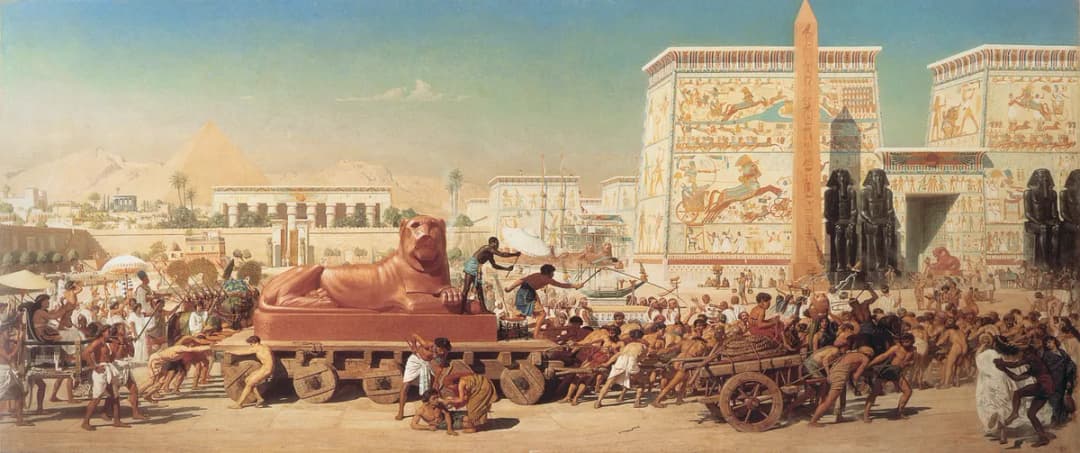
Egypt's connection with biblical history is more extensive than any nation except Israel itself. Abraham sojourned there during a famine, where his deception regarding Sarah was exposed. Joseph was sold into Egypt around 1728 BC, rising to become Pharaoh's vizier and eventually bringing Jacob's family to settle in Goshen, the best of the land. After centuries of prosperity, a new dynasty arose that did not know Joseph, reducing the Israelites to brutal slavery. God raised Moses to deliver His people through the ten plagues, culminating in the death of the firstborn and the destruction of Pharaoh's army in the Red Sea. In later centuries, Egypt featured in the divided kingdom's history: Shishak invaded Judah under Rehoboam, Zerah the Ethiopian was defeated by Asa, and various pharaohs formed alliances with Israel's kings. The New Testament records Joseph and Mary fleeing to Egypt with the infant Jesus to escape Herod's massacre, fulfilling Hosea's prophecy: "Out of Egypt I called my son."
☩Religion and Culture
Ancient Egypt was divided into nomes, each with its distinctive worship and local deities. The nation was renowned for its magi and priests, whose wisdom was celebrated throughout the ancient world, though their sorcery proved powerless against God's plagues. The monuments, with their hieroglyphic inscriptions, have survived remarkably due to Egypt's dry climate, providing invaluable historical records. Egypt's linen was superior to modern manufacture, and its papyrus provided the writing material for much of antiquity. By the New Testament period, Egypt, particularly Alexandria, housed a significant Jewish population estimated at one million, who had developed a distinctive Hellenistic Judaism that produced the Septuagint translation and philosophers like Philo.
☩Prophetic Significance
The prophets pronounced extensive judgments against Egypt, foretelling its humiliation and desolation. Isaiah, Jeremiah, and Ezekiel all prophesied against the proud nation that trusted in its own resources rather than the living God. Yet these prophecies also contained hope: Egypt would be among the nations that would one day worship the Lord, with a highway connecting it to Assyria through Israel. In Revelation, "the great city which spiritually is called Sodom and Egypt" represents opposition to God's people, though scholars debate whether this refers to Jerusalem or Rome.
Related Verses578 mentions
References
- 1.John McClintock and James Strong, "Egypt," in Cyclopedia of Biblical, Theological and Ecclesiastical Literature, vol. III (Harper & Brothers, 1867–1887).
- 2.Andrew Robert Fausset, "Egypt," in The Englishman's Critical and Expository Bible Cyclopædia (Hodder & Stoughton, 1878).
- 3.F. N. Peloubet & M. A. Peloubet (ed.), "Egypt," in Smith's Bible Dictionary (Porter & Coates, 1884).
- 4.George Morrish, "Egypt," in Morrish's Concise Bible Dictionary (George Morrish, 1898).
- 5.James Orr (ed.), "Egypt," in International Standard Bible Encyclopedia, vol. II (Howard-Severance Company, 1915).
- 6.James Hastings (ed.), "Egypt," in Dictionary of the Apostolic Church, vol. I (T. & T. Clark, 1915–1918).