
King
“Ruler, one who reigns”
Summary
The supreme ruler of a nation or territory, a title applied in Scripture to human monarchs, to God as sovereign of the universe, and to Christ as head of His Church and coming Messiah.
☩Biblical Usage of the Title
The title "king" in Scripture does not always imply the same degree of power or territory. Many persons called kings would more accurately be termed chiefs or leaders, and many single towns with their adjacent villages had their own kings. This explains how Canaan could contain thirty-one kings conquered by Joshua, and how Adonibezek could mention seventy kings whom he had subdued. In the New Testament, the title is applied to the Roman emperor, to Herod Antipas (though technically only a tetrarch), and to provincial governors exercising supreme authority within their jurisdictions. Symbolically, the term signifies the possessor of supreme power, applied to God as sovereign of the universe, to Christ as head of His Church, and to believers who will reign with Him.
☩Origin of Hebrew Monarchy
Regal authority was alien to Moses' original institutions, whose fundamental idea was that Jehovah alone was king of the nation. Yet Moses anticipated that the people would eventually desire a king "like all the nations" and provided guidelines for that contingency. The immediate occasion for demanding a king was the siege of Jabesh-Gilead by Nahash the Ammonite and the corruption of Samuel's sons who served as judges. The people's request displeased Samuel, but God instructed him to grant it while warning them of a king's prerogatives. Saul was then chosen by divine direction from the tribe of Benjamin. The sin in their request lay not in wanting a king per se, but in their impatient distrust of God's protection and their desire to be like surrounding nations.
☩Constitutional Limitations
The Hebrew king, unlike Eastern despots, operated under significant constitutional restrictions. He was to be chosen by God from among the Israelites, not a foreigner. He was forbidden to multiply horses from Egypt (which would entail dangerous foreign alliances), to accumulate many wives who might turn his heart away, or to amass excessive silver and gold. Most importantly, he was required to write a copy of the law and read it daily, so that his heart would not be lifted above his brethren. The king held only delegated authority as God's vicegerent; Jehovah remained the true Judge, Lawgiver, and King of Israel. Samuel wrote down "the manner of the kingdom," defining the rights and duties of the king in relation to God and the nation.
☩Royal Prerogatives and Duties
The king served as commander-in-chief of the army, supreme judge, and had authority to impose taxes and exact personal service. He led the people in battle and executed judgment and justice in peace and war. Yet these powers came with accountability. He was bound to consult God through the high priest's Urim and Thummim in important matters, and the prophets served as his advisers, reprovers, and intercessors with God. The king's court included the recorder who wrote annals, a scribe or secretary for correspondence, an officer over the house, a captain of the bodyguard, and various counselors. His revenues came from demesnes, flocks, tithes, levies, tariffs, and presents that became a form of regular taxation.
☩Sacred Character of Kingship
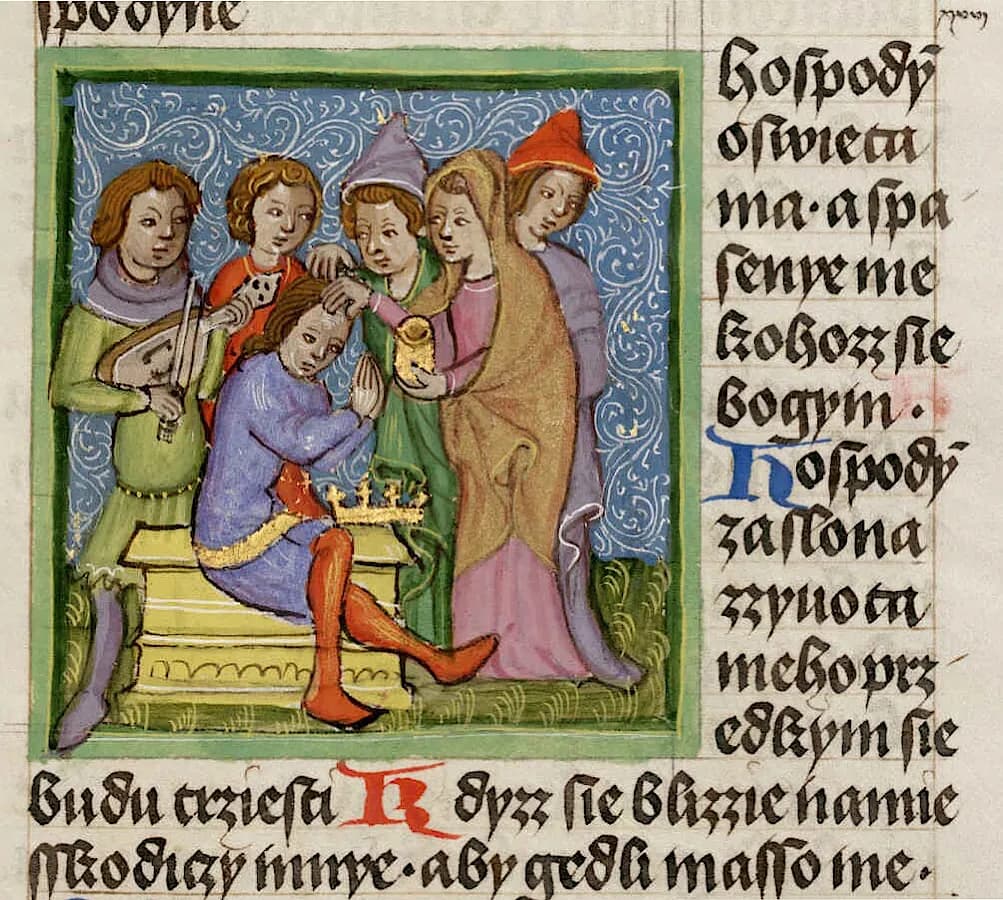
The Hebrew king held a sacred character as "the Lord's anointed." Upon his head was poured the holy anointing oil previously reserved exclusively for the priests of Jehovah. This consecration made it sacrilegious to kill him, even at his own request, as David repeatedly acknowledged regarding Saul. The king was described as God's son in a representative sense, and divine promises were attached to the Davidic dynasty. This sacred character made the king a type of the Messiah, the ultimate Anointed One. The royal insignia included a crown or diadem of pure gold adorned with precious gems, and a royal scepter. Those approaching the king did obeisance, bowing down and touching the ground with their foreheads, calling themselves his servants.
☩Christ as King
The title "King" finds its ultimate fulfillment in Christ. The early Church believed Jesus was installed in His royal office by the resurrection, fulfilling the prophecy "Thou art my son; this day have I begotten thee." Christ possesses a kingdom "not of this world," a heavenly rather than earthly sovereignty. He sits at the right hand of God, participating in divine government, with angels, authorities, and powers made subject to Him. His reign continues until all enemies are put under His feet, the last enemy being death. Some passages suggest His kingdom is already present, while others point to its full manifestation at His return. Ultimately He is "King of kings and Lord of lords," exercising unlimited authority over all earthly and heavenly powers.
Related Verses2254 mentions
See Also
References
- 1.John McClintock and James Strong, "King," in Cyclopedia of Biblical, Theological and Ecclesiastical Literature, vol. V (Harper & Brothers, 1867–1887).
- 2.F. N. Peloubet & M. A. Peloubet (ed.), "King," in Smith's Bible Dictionary (Porter & Coates, 1884).
- 3.Andrew Robert Fausset, "King," in The Englishman's Critical and Expository Bible Cyclopædia (Hodder & Stoughton, 1878).
- 4.James Hastings (ed.), "King," in Dictionary of the Apostolic Church, vol. I (T. & T. Clark, 1915–1918).
- 5.James Hastings (ed.), "King," in Dictionary of Christ and the Gospels, vol. I (T. & T. Clark, 1906–1908).