
Hinnom
“Valley of Hinnom (ben-Hinnom = son of Hinnom)”
Summary
The Valley of Hinnom (or Ben-Hinnom, 'son of Hinnom') was a ravine south of Jerusalem notorious for the child sacrifices to Moloch and later becoming the refuse dump whose fires gave rise to Gehenna as a symbol of hell.
☩Location and Identification
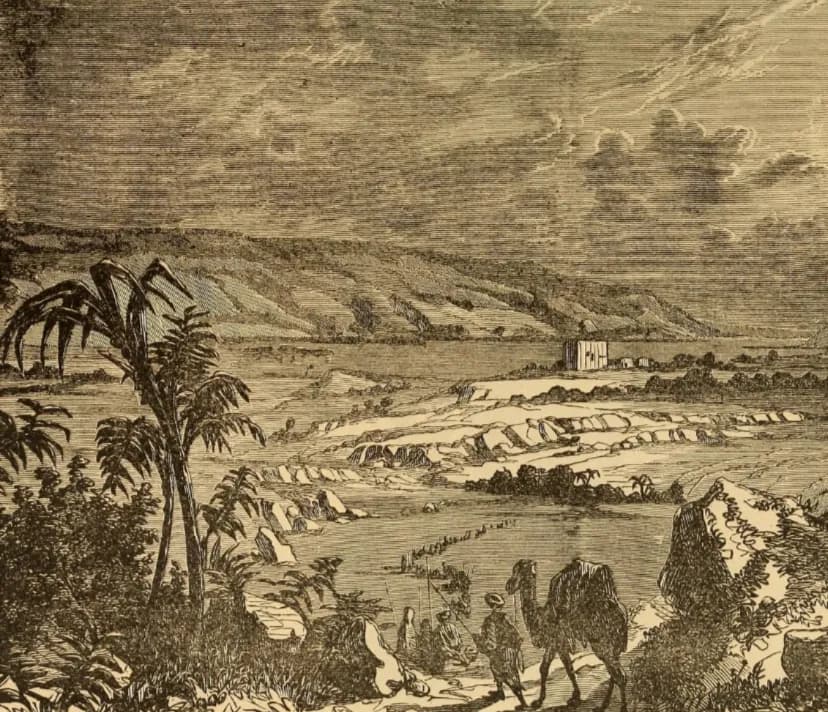
The Valley of Hinnom is a deep, narrow ravine with steep rocky sides on the south and southwest of Jerusalem, separating Mount Zion from the 'Hill of Evil Counsel' and the plain of Rephaim. It formed part of the boundary between the tribes of Judah and Benjamin. The valley is described as passing along the south side of the Jebusite stronghold (Mount Zion) from En-Rogel westward. Today it is called Wady er-Rubeb or, among Muslims, Wady Jehennam.
☩The Worship of Moloch
The valley obtained fearful notoriety as the scene of the barbarous rites of Moloch and Chemosh, first introduced by Solomon. A monstrous brass idol was erected there, and children were caused to 'pass through the fire'—actually being burned as offerings. Ahaz and Manasseh made their own sons pass through the fire in this valley. No spot near Jerusalem was better suited for such horrors: a deep, retired glen shut in by rugged cliffs. The Hebrew word toph ('drum' or 'timbrel') may have given rise to the name Tophet, either because drums were used to drown the children's screams or because the word meant 'a place of burning.'
☩Josiah's Reformation
King Josiah defiled the valley to end forever the abominations practiced there. He broke down the altars and high places, scattered human bones over Tophet, and rendered the place ceremonially unclean so that no Jew could enter it. The place thus became the common cesspool of the city, receiving its sewage and refuse. Fires were kept burning to consume the garbage, and the 'worm' of decay was always at work there. Jeremiah prophesied that the valley would be called 'the valley of slaughter' where they would bury until there was no more room.
☩Origin of Gehenna
The inhuman rites practiced there and its subsequent defilement caused the later Jews to regard the Valley of Hinnom with horror and detestation. The Greek form of Ge-Hinnom ('Valley of Hinnom') became Gehenna, which the Jews applied to the place of eternal punishment. Two passages from Isaiah particularly shaped this imagery: 'Tophet is ordained of old... the pile thereof is fire and much wood' and the description of those whose 'worm shall not die, neither shall their fire be quenched.' Jesus used Gehenna twelve times in the Gospels, and James once, always referring to the place of final punishment.
Related Verses14 mentions
See Also
References
- 1.John McClintock and James Strong, "Hinnom," in Cyclopedia of Biblical, Theological and Ecclesiastical Literature, vol. IV (Harper & Brothers, 1867–1887).
- 2.F. N. Peloubet & M. A. Peloubet (ed.), "Hinnom," in Smith's Bible Dictionary (Porter & Coates, 1884).
- 3.American Tract Society, "Hinnom," in American Tract Society Bible Dictionary (American Tract Society, 1859).
- 4.John Kitto, "Hinnom," in A Cyclopedia of Biblical Literature, vol. I (Mark H. Newman, 1845).