
Paul
“Asked for, desired (his Hebrew name Saul); Paul (Greek Paulos, from Latin Paulus) means 'small' or 'little'”
Summary
Paul, originally named Saul, was the specially appointed apostle to the Gentiles, a Roman citizen from Tarsus who was converted on the road to Damascus and became the most influential missionary and theologian of the early Church.
☩Background and Early Life
Paul was born in Tarsus, a prominent city of Cilicia renowned as a center of Greek learning rivaling Athens and Alexandria. He was of the tribe of Benjamin, a 'Hebrew of the Hebrews,' and inherited Roman citizenship from his father, who was a Pharisee. His Hebrew name Saul honored King Saul of the same tribe. At Tarsus he acquired fluency in Greek and learned the trade of tent-making using the goat-hair cloth called cilicium. His primary education was at Jerusalem 'at the feet of Gamaliel,' the eminent Pharisee, where he was trained rigorously in the law. This unique combination of Hebrew learning, Greek culture, and Roman citizenship providentially equipped him for his apostolic mission.
☩Persecution and Conversion
Paul first appears in Scripture as a young man at whose feet the witnesses laid their garments while stoning Stephen, 'consenting unto his death.' His pharisaic zeal drove him to devastate the church, entering houses to drag men and women to prison. Armed with letters from the high priest, he traveled to Damascus to arrest Christians there. Near the city, a light brighter than the noonday sun struck him down, and the risen Christ spoke: 'Saul, Saul, why persecutest thou Me?' Blinded for three days, neither eating nor drinking, he was visited by Ananias, who restored his sight and baptized him. Paul later recounted that Christ appeared to him as 'one born out of due time,' the last of the apostles to witness the risen Lord.
☩Early Ministry and First Journey
Immediately after conversion, Paul preached in Damascus synagogues that Jesus was the Son of God, then withdrew to Arabia before returning to Damascus. After three years, he visited Jerusalem briefly, meeting Peter and James, then went to his native Tarsus. Barnabas brought him to Antioch, where they labored together for a year. The Holy Spirit set apart Barnabas and Saul for missionary work, launching the first journey (c. AD 45-49) through Cyprus and southern Asia Minor. At Paphos, the proconsul Sergius Paulus was converted, and from this point Luke calls him Paul. They established churches in Pisidian Antioch, Iconium, Lystra, and Derbe despite fierce Jewish opposition and Paul's stoning at Lystra.
☩Jerusalem Council and Later Journeys
A dispute over Gentile circumcision brought Paul and Barnabas to Jerusalem's council (c. AD 49), where the apostles affirmed that Gentiles need not be circumcised. On his second journey, Paul took Silas through Asia Minor and, responding to a vision, crossed into Europe, establishing churches at Philippi, Thessalonica, Berea, and Corinth, where he stayed eighteen months. His third journey centered on a three-year ministry at Ephesus, from which he wrote several epistles. Throughout these travels, Paul faced shipwrecks, beatings, imprisonments, and constant Jewish opposition, yet he established Christianity firmly across the Roman world.
☩Imprisonment and Final Years
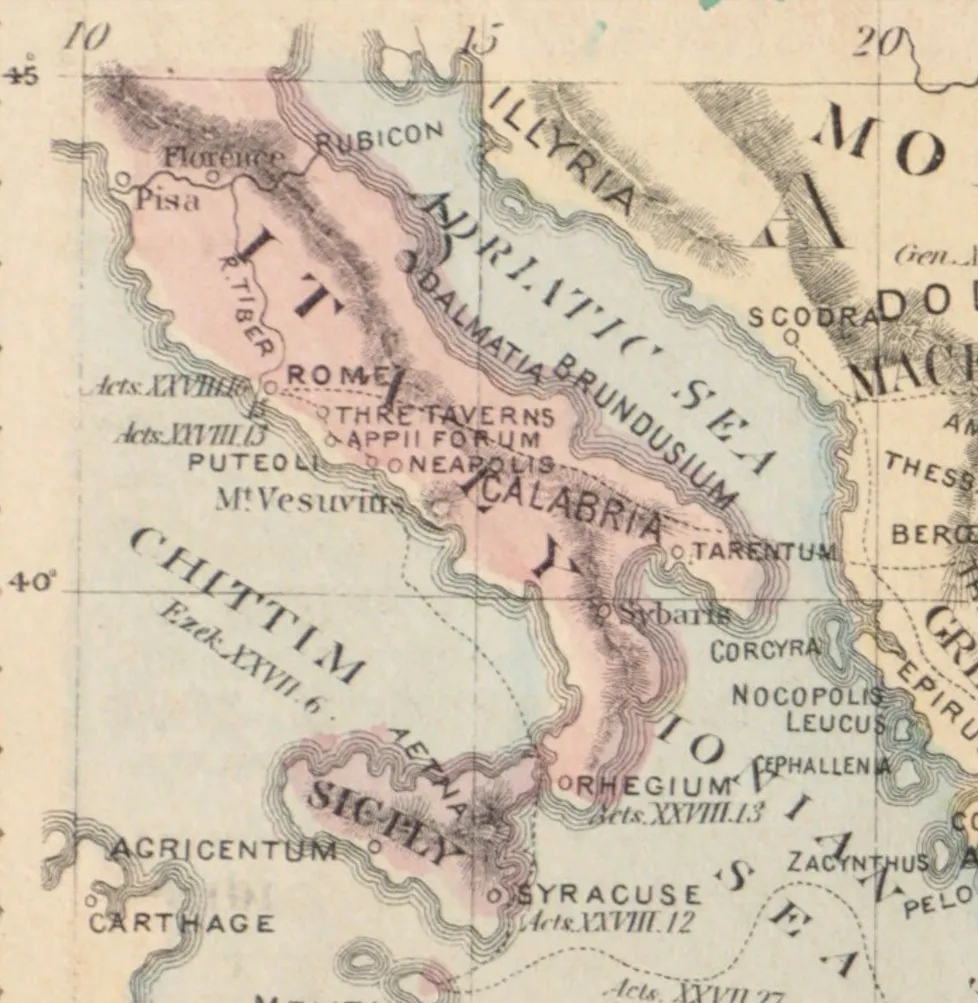
Returning to Jerusalem despite prophetic warnings, Paul was seized in the temple and rescued by Roman soldiers. After two years' imprisonment at Caesarea under Felix and Festus, he appealed to Caesar and was sent to Rome, surviving shipwreck at Malta. In Rome he lived two years in his own rented quarters, preaching the kingdom of God to all who came. Church tradition indicates he was released, traveled further (possibly to Spain as he had intended), then was rearrested and martyred under Nero. His final epistle, 2 Timothy, written from prison, expresses confidence: 'I have fought a good fight, I have finished my course, I have kept the faith.'
☩Theological Contribution
Paul received his gospel directly from Christ through revelation, not from the other apostles. He was the first Christian theologian to systematically formulate doctrine, developing the truths of justification by faith, union with Christ, and the Church as Christ's body. His thirteen epistles address both practical church problems and profound theological questions. To him was revealed 'the mystery' that Gentiles are fellow heirs with Jews in one body. His teaching that 'Christ our Passover is sacrificed for us' and his exposition of grace versus law have shaped Christian understanding for two millennia. He considered himself 'the chief of sinners' saved by grace, making his life a testimony to divine mercy.
Related Verses288 mentions
See Also
References
- 1.John McClintock and James Strong, "Paul," in Cyclopedia of Biblical, Theological and Ecclesiastical Literature, vol. VII (Harper & Brothers, 1867–1887).
- 2.James Orr (ed.), "Paul, The Apostle," in International Standard Bible Encyclopedia, vol. IV (Howard-Severance Company, 1915).
- 3.James Hastings (ed.), "Paul," in Dictionary of the Apostolic Church, vol. II (T. & T. Clark, 1915–1918).
- 4.James Hastings (ed.), "Paul," in Dictionary of Christ and the Gospels, vol. II (T. & T. Clark, 1906–1908).
- 5.George Morrish, "Paul," in Morrish's Concise Bible Dictionary (George Morrish, 1898).
- 6.F. N. Peloubet & M. A. Peloubet (ed.), "Paul," in Smith's Bible Dictionary (Porter & Coates, 1884).