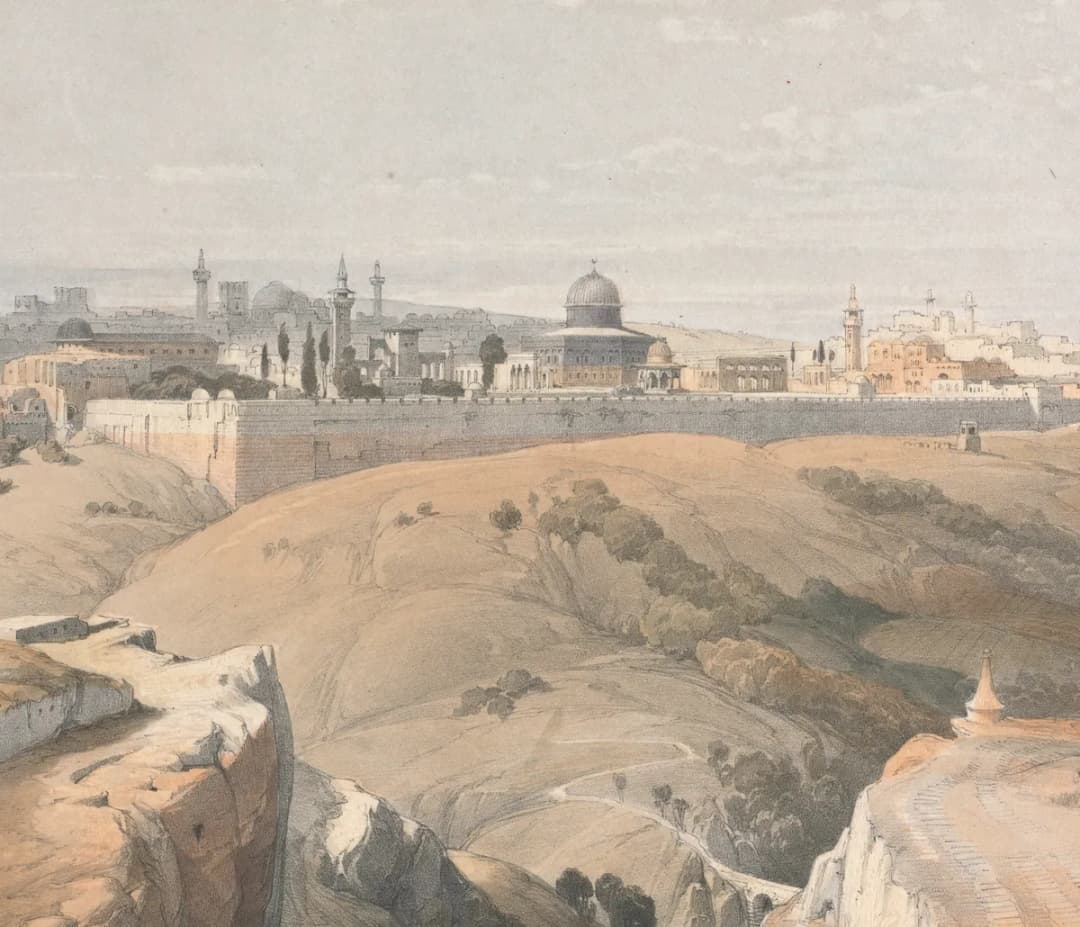
Mount of Olives(olivet)
Summary
A ridge of hills east of Jerusalem, separated from the city by the Kidron Valley, bearing profound significance in the ministry of Jesus Christ.
☩Geography and Names
The Mount of Olives rises east of Jerusalem, separated from the city by the deep Kidron Valley. Arabs call it Jebel et-Tûr ('mountain of the tower') or Jebel ez-Zeitûn ('mount of olives'). Jews also called it 'mountain of light' because beacon-fires were kindled here to signal each new moon throughout the land. The ridge reaches approximately 2,723 feet above sea level.
☩Old Testament Significance
King David crossed the Mount of Olives barefoot and weeping when fleeing from Absalom (2 Samuel 15:30). Solomon built high places on its southern spur for his foreign wives' gods, earning it the name 'Mount of Corruption' (2 Kings 23:13). The prophet Zechariah foretold that the Lord's feet would stand upon the Mount of Olives in the day of His coming (Zechariah 14:4).
☩Jesus' Ministry
Jesus made His triumphant entry into Jerusalem from the Mount of Olives (Matthew 21:1; Mark 11:1; Luke 19:29, 37). Here He wept over the city and foretold its destruction (Luke 19:41-44). On this mount He delivered His Olivet Discourse concerning the end times (Matthew 24:3; Mark 13:3). The Garden of Gethsemane, where Jesus agonized in prayer before His arrest, lies on its western slopes (Matthew 26:30; Mark 14:26; Luke 22:39).
☩The Ascension
After His resurrection, Jesus led His disciples to the Mount of Olives and ascended into heaven from near Bethany (Luke 24:50; Acts 1:12). The angels announced He would return 'in like manner' as the disciples had seen Him go. The southern summit, traditionally the site of the Ascension, bears Constantine's Church of the Ascension, built in 316 AD.
☩Associated Villages
The villages of Bethphage ('house of figs') and Bethany ('house of dates') on the Mount's eastern slopes indicate the area's fertility with olive, fig, and palm trees. Bethany, where Jesus raised Lazarus and stayed with Mary, Martha, and Lazarus, should be considered part of the Mount (Luke 19:29; 24:50).