
Crucifixion
Summary
The Roman method of execution by which criminals were nailed or bound to a wooden cross, considered the most agonizing and shameful form of death, by which Jesus Christ accomplished redemption.
☩History and Practice
Crucifixion was practiced by Egyptians, Carthaginians, Persians, Assyrians, Greeks, and Romans. Among the Romans, it was considered the most horrible form of death, reserved primarily for slaves and the worst criminals. Roman citizens were generally exempt from this punishment. The victim was typically scourged first, then required to carry the crossbeam to the place of execution, where his hands and feet were nailed to the wooden structure.
☩The Agony of the Cross
Death by crucifixion was designed to maximize suffering over an extended period. The unnatural position caused severe muscle cramps; the wounds from the nails brought intense inflammation; traumatic fever, thirst, and exposure to the elements added to the torment. Victims could linger for days before death finally came from exhaustion, heart failure, or asphyxiation. A stupefying drink was sometimes offered to lessen the pain, which Jesus refused (Matthew 27:34).
☩Christ's Crucifixion
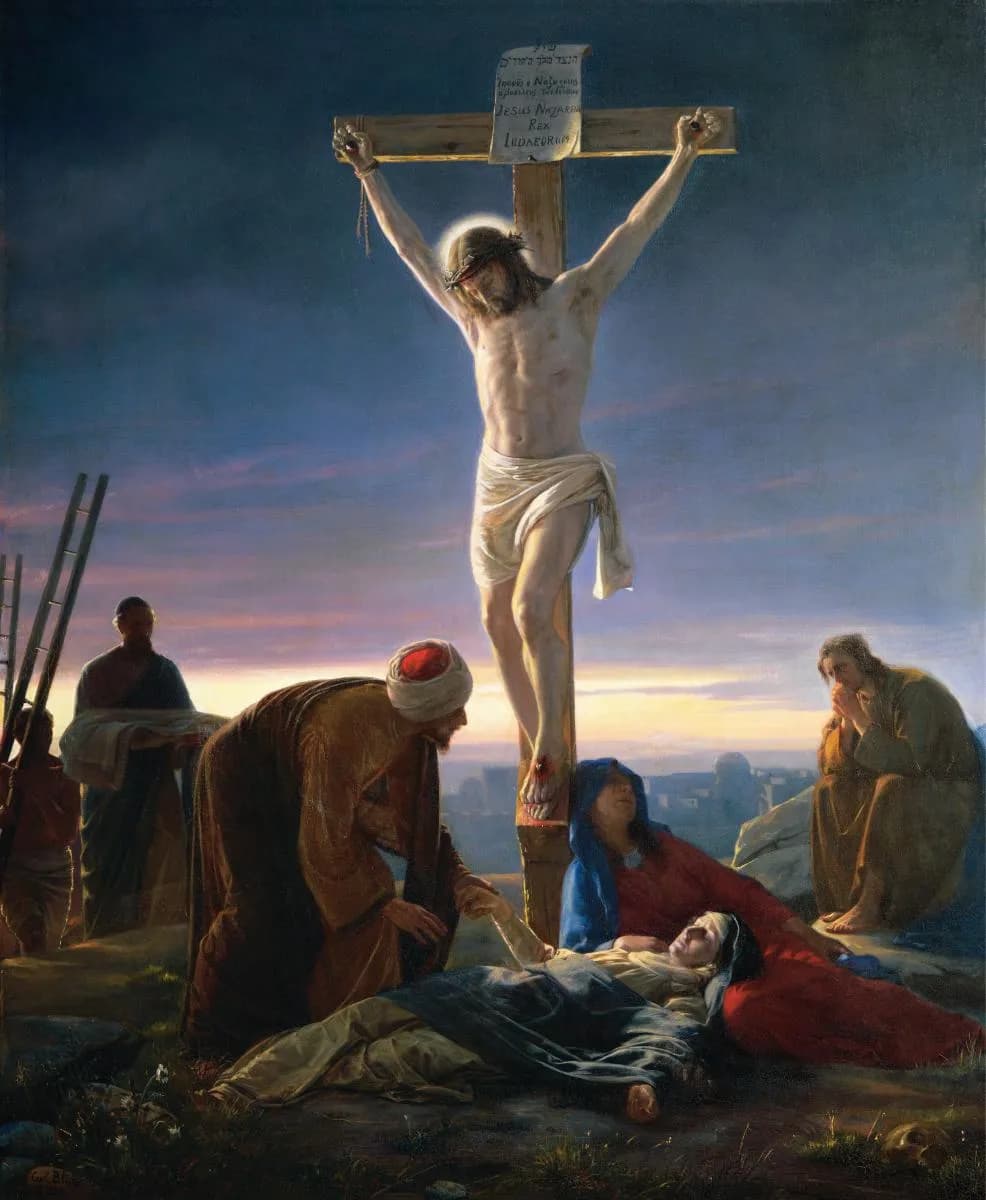
Jesus was crucified outside Jerusalem at a place called Golgotha, between two criminals (Matthew 27:33, 38). He was on the cross from approximately the third hour (9 a.m.) until the ninth hour (3 p.m.), when He voluntarily gave up His spirit (Mark 15:25, 37). The remarkable brevity of His death surprised Pilate, since crucifixion victims often survived much longer. His legs were not broken, fulfilling the Passover type (John 19:33, 36; Exodus 12:46). Astronomical calculations confirm a partial lunar eclipse occurred on Friday, April 3, AD 33—one of only two Fridays during Pilate's governorship that fell on Nisan 14. The moon rose over Jerusalem already in eclipse, likely appearing blood-red due to atmospheric scattering, possibly fulfilling the sign Peter quoted at Pentecost: 'the moon into blood' (Acts 2:20; see Eclipse).
☩Theological Significance
The crucifixion of Christ transformed an instrument of shame into the symbol of salvation. Scripture declares that Christ became a curse for us, bearing the penalty of sin (Galatians 3:13). Believers are said to be crucified with Christ, having died to sin and the law (Romans 6:6; Galatians 2:20). The preaching of 'Christ crucified' remains the heart of the gospel message, the power of God for salvation (1 Corinthians 1:18, 23-24).
Related Verses8 mentions
See Also

References
- 1.John McClintock and James Strong, "Crucifixion," in Cyclopedia of Biblical, Theological and Ecclesiastical Literature, vol. II (Harper & Brothers, 1867–1887).
- 2.F. N. Peloubet & M. A. Peloubet (ed.), "Crucifixion," in Smith's Bible Dictionary (Porter & Coates, 1884).
- 3.George Morrish, "Crucifixion," in Morrish's Concise Bible Dictionary (George Morrish, 1898).
- 4.Colin J. Humphreys and W. Graeme Waddington, "Dating the Crucifixion" (Nature, 306(5945), 743–746., 1983).