
Priest(high priest)
“One who draws near, minister, priest”
Summary
A priest is one divinely appointed to minister in sacred things, particularly to offer sacrifices at the altar, acting as a mediator between God and humanity—an office that reached its ultimate fulfillment in Christ, the great High Priest after the order of Melchizedek.
☩Name and Essential Idea
The Hebrew word kohen is probably derived from a root meaning 'to draw near'—the priest being one who may approach the divine presence while others stand afar off. The English word 'priest' derives from the Greek presbyter ('elder'), though its meaning corresponds to the Greek hiereus (one who offers sacrifice). The essential idea of Hebrew priesthood is mediation: the priest represented the people as holy before Jehovah, preparing a way by which they themselves might approach God. Israel was chosen to be 'a kingdom of priests' to the Gentile nations (Exodus 19:6), but the nation's sinfulness made them unfit to penetrate into God's immediate presence, hence the necessity of having individual representatives to mediate between them and God.
☩Pre-Mosaic Priesthood
Before the Aaronic priesthood was established, the head of the family acted as priest, the office descending with the birthright. No trace of a hereditary caste priesthood exists in the patriarchal age. Melchizedek stands alone as 'priest of the Most High God' (Genesis 14:18), combining kingship and priesthood without human predecessor or successor. Job offered sacrifices for his children (Job 1:5), and Jethro was priest of Midian (Exodus 2:16). At the Exodus, before Aaron's consecration, Moses appointed 'young men of the children of Israel' to offer burnt offerings and peace offerings (Exodus 24:5). The Levites and firstborn sons had certain priestly functions before the establishment of the Aaronic order.
☩Establishment of the Aaronic Priesthood
When the tabernacle was completed, Aaron and his sons were consecrated as priests to minister before the Lord (Exodus 28-29; Leviticus 8). The priesthood was first established in Aaron's family, and all Aaron's sons were priests, standing between the high priest and the Levites. Divine selection severed them from those for whom they were to act—the priest was not elected by the people nor self-appointed but called of God, 'even as was Aaron' (Hebrews 5:4). The ceremony of consecration involved washing with water, clothing with sacred garments, anointing with oil, and offering of sacrifices, with blood applied to the right ear, thumb, and toe. This elaborate ritual signified their complete dedication and fitness to serve in holy things.
☩Priestly Functions
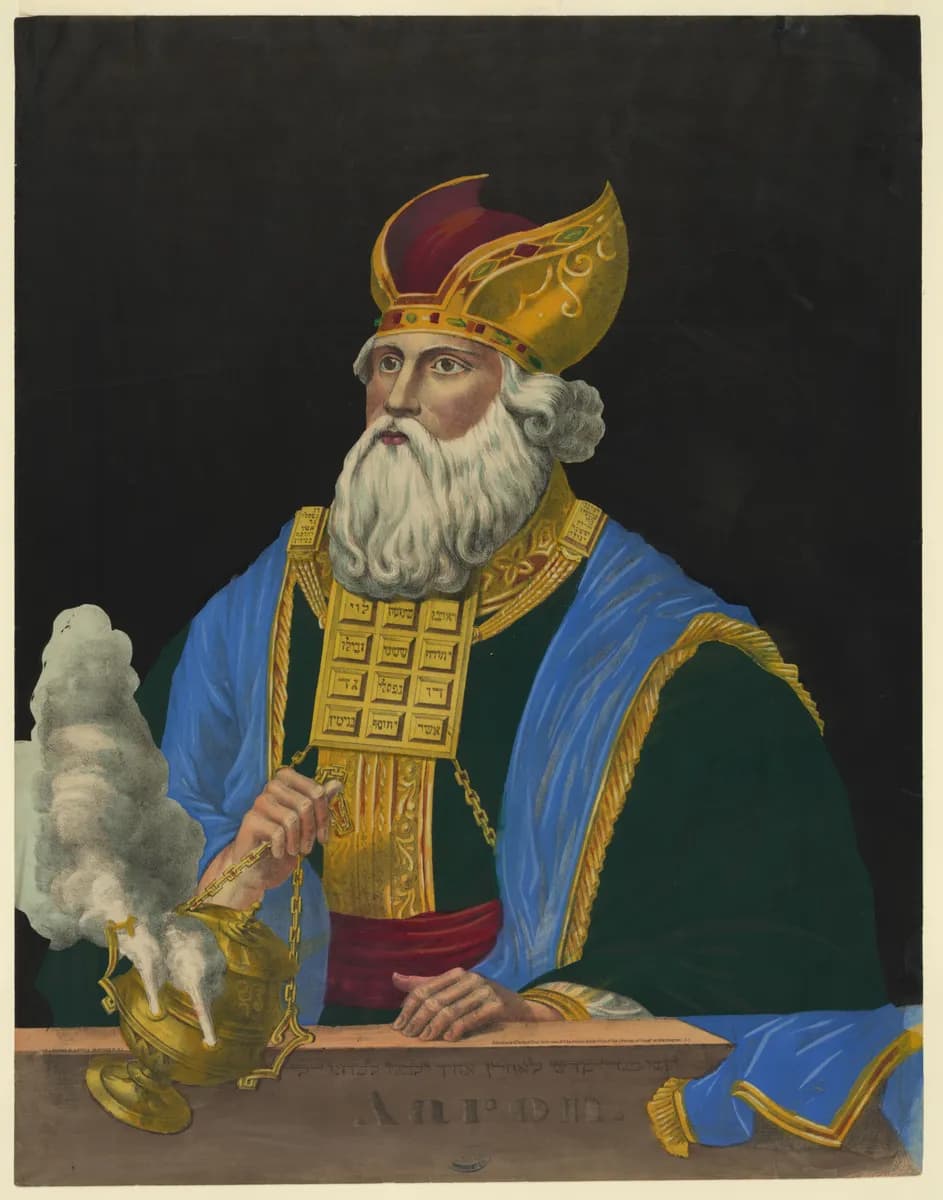
The chief duties included: watching over the fire on the altar of burnt offering, keeping it burning continually (Leviticus 6:12); feeding the golden lamp with oil (Exodus 27:20-21); offering morning and evening sacrifices (Exodus 29:38-44); and teaching Israel the statutes of the Lord (Leviticus 10:11). They were to cover the ark and sanctuary vessels before the Levites might approach them for transport, and to blow the silver trumpets for assembly and march (Numbers 10:1-8). The priests acted as a court of appeal in difficult controversies (Deuteronomy 17:8-13). Their essential function was representation: bearing the tribal names on the high priest's shoulders and breastplate symbolized his appearing before God for all Israel (Exodus 28:12, 29).
☩Priestly Garments and Support
The priests wore linen drawers with a close-fitting white cassock, gathered with a girdle of needlework in blue, purple, and scarlet. Upon their heads they wore caps shaped like a cup-flower, also of fine linen. In all ministration they were barefoot (Exodus 28:39-40). For their support, God provided: one-tenth of the Levites' tithes; a special tithe every third year; redemption money for the firstborn; spoil from warfare; portions of burnt, peace, and trespass offerings; the heave-shoulder and wave-breast; firstfruits of corn, wine, and oil; and thirteen cities with pasture grounds (Joshua 21). These provisions secured them against poverty while preventing undue wealth or political ambition.
☩The Priesthood of Christ
The Epistle to Hebrews presents Christ as both priest and sacrifice, the antitype of all the Jewish priesthood's distinctive features. He is priest after the order of Melchizedek—not Aaron—combining kingship and priesthood eternally (Hebrews 5:6; 7:1-17). His priesthood does not 'pass from one to another' because 'He ever liveth' (Hebrews 7:24-25). Christ fulfilled all four priestly characteristics: chosen of God, the property of God, holy to God, and offering gifts to God (Hebrews 5:1-4). All the elect saints are now called to be 'priests unto God' (1 Peter 2:5, 9; Revelation 1:6), with direct access through Christ to the Father. Christian ministers are never called hiereis ('sacrificing priests') in the New Testament—only diakonoi (servants), huperetai (ministers), and presbuteroi (elders).
Related Verses964 mentions
See Also

References
- 1.John McClintock and James Strong, "Priest, Hebrew," in Cyclopedia of Biblical, Theological and Ecclesiastical Literature, vol. VIII (Harper & Brothers, 1867–1887).
- 2.James Orr (ed.), "Priest," in International Standard Bible Encyclopedia, vol. IV (Howard-Severance Company, 1915).
- 3.James Hastings (ed.), "Priest," in Dictionary of the Apostolic Church, vol. II (T. & T. Clark, 1915–1918).
- 4.James Hastings (ed.), "Priest," in Dictionary of Christ and the Gospels, vol. II (T. & T. Clark, 1906–1908).
- 5.Andrew Robert Fausset, "Priest," in The Englishman's Critical and Expository Bible Cyclopædia (Hodder & Stoughton, 1878).
- 6.F. N. Peloubet & M. A. Peloubet (ed.), "Priest," in Smith's Bible Dictionary (Porter & Coates, 1884).