
Tabernacle(holy place, pavilion)
“Dwelling place”
Summary
The Tabernacle was the portable sanctuary constructed by Moses according to divine instructions, serving as God's dwelling place among Israel during their wilderness wanderings.
☩Names and Terminology
The Tabernacle is designated by several Hebrew terms. Mishkan, from the verb 'to dwell,' refers to the dwelling place of divine glory and connects with the concept of the Shekinah. Ohel means 'tent' and typically requires a qualifying epithet when applied to the sacred structure. The full designation 'Tent of Meeting' (ohel moed) does not refer to the congregation meeting together, but to God meeting with His people to commune with them. Other terms include 'Tabernacle of Testimony' (referring to the tablets of the law within), 'Sanctuary,' and 'House of the Lord.'
☩Structure and Construction
The Tabernacle consisted of a wooden framework of acacia boards covered with curtains. The structure measured thirty cubits long, ten cubits wide, and ten cubits high. The boards, forty-eight in number, were overlaid with gold and set in silver sockets, connected by horizontal bars. Four coverings protected the structure: an innermost curtain of fine linen embroidered with cherubim in blue, purple, and scarlet; a curtain of goats' hair; a covering of rams' skins dyed red; and an outer covering of tachash (likely seal) skins. The materials were contributed voluntarily by the people, and skilled craftsmen Bezalel and Oholiab were divinely appointed to oversee construction.
☩The Holy Place and Holy of Holies
The interior was divided by a veil into two chambers: the Holy Place (twenty cubits long) and the Most Holy Place or Holy of Holies (a perfect cube of ten cubits). The Holy Place contained the golden lampstand on the south side, the table of showbread on the north, and the altar of incense before the veil. The Holy of Holies contained only the Ark of the Covenant surmounted by the cherubim and mercy seat. Only priests could enter the Holy Place for daily ministry, while the Holy of Holies was entered only by the high priest once yearly on the Day of Atonement.
☩The Court and Outer Furnishings
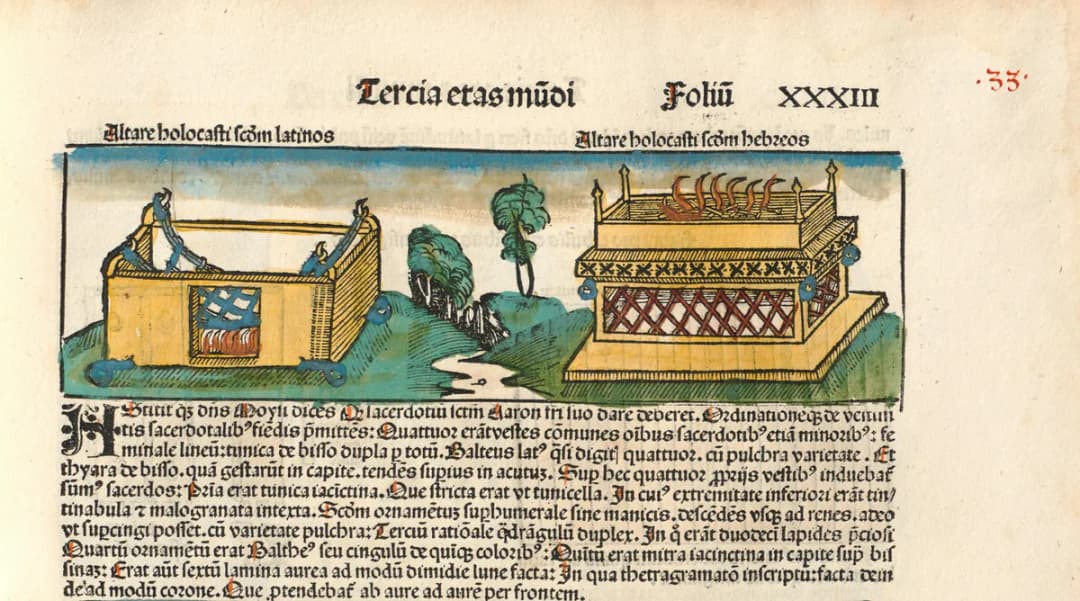
The Tabernacle stood within a courtyard measuring one hundred cubits by fifty cubits, enclosed by linen hangings suspended from sixty bronze pillars. Within the court stood the bronze altar of burnt offering, where sacrifices were made, and the bronze laver where priests washed before ministering. The single entrance faced east, and the altar positioned near it signified that approach to God required sacrifice.
☩Typological Significance
The writer of Hebrews interprets the Tabernacle as a 'copy and shadow' of heavenly realities. Christ is presented as the minister of 'the true tabernacle which the Lord pitched, not man,' having entered the heavenly sanctuary by His own blood. The Gospel of John states that 'the Word became flesh and tabernacled among us,' using the same imagery. The rending of the Temple veil at Christ's crucifixion symbolized that access to God's presence was now open to all believers through Christ.
☩Later History
After Israel entered Canaan, the Tabernacle was established at various locations: first at Gilgal, then at Shiloh where it remained for centuries. Due to Israel's unfaithfulness, God forsook the Tabernacle at Shiloh. It later appeared at Nob and then Gibeon. When Solomon built the Temple, the Tabernacle and its holy vessels were brought up to Jerusalem, and the Ark found its permanent resting place in the Most Holy Place.
Related Verses447 mentions
References
- 1.John McClintock and James Strong, "Tabernacle," in Cyclopedia of Biblical, Theological and Ecclesiastical Literature, vol. X (Harper & Brothers, 1867–1887).
- 2.James Hastings (ed.), "Tabernacle," in Dictionary of the Apostolic Church, vol. II (T. & T. Clark, 1915–1918).
- 3.George Morrish, "Tabernacle," in Morrish's Concise Bible Dictionary (George Morrish, 1898).
- 4.Philip Schaff and Johann Herzog (ed.), "TABERNACLE," in The New Schaff-Herzog Encyclopedia of Religious Knowledge, vol. XI (Funk and Wagnalls, 1908–1914).
- 5.F. N. Peloubet & M. A. Peloubet (ed.), "Tabernacle," in Smith's Bible Dictionary (Porter & Coates, 1884).