
Blood
“Blood, from a root suggesting redness”
Summary
The life-bearing fluid of animals and humans, sacred to God, forbidden as food, and central to both Old Testament sacrifices and the atoning work of Christ.
☩Blood as Life
Scripture ascribes to blood the mysterious sacredness belonging to life itself, declaring that 'the life of all flesh is in the blood.' This identification of blood with life was recognized from earliest times, as loss of blood meant loss of life. Because life belongs to God alone, blood was reserved to Him and could not be consumed as food, a prohibition given to Noah and reiterated throughout the Mosaic law.
☩Prohibition Against Eating Blood
From the time permission was given to eat animal flesh, blood was expressly forbidden as food. Under the Mosaic code, the penalty for eating blood was being 'cut off from the people.' The prohibition extended even to strangers residing among Israel. The Jerusalem Council in Acts renewed this injunction for Gentile Christians, coupling abstinence from blood with abstinence from things offered to idols and from fornication.
☩Blood in Old Testament Sacrifice
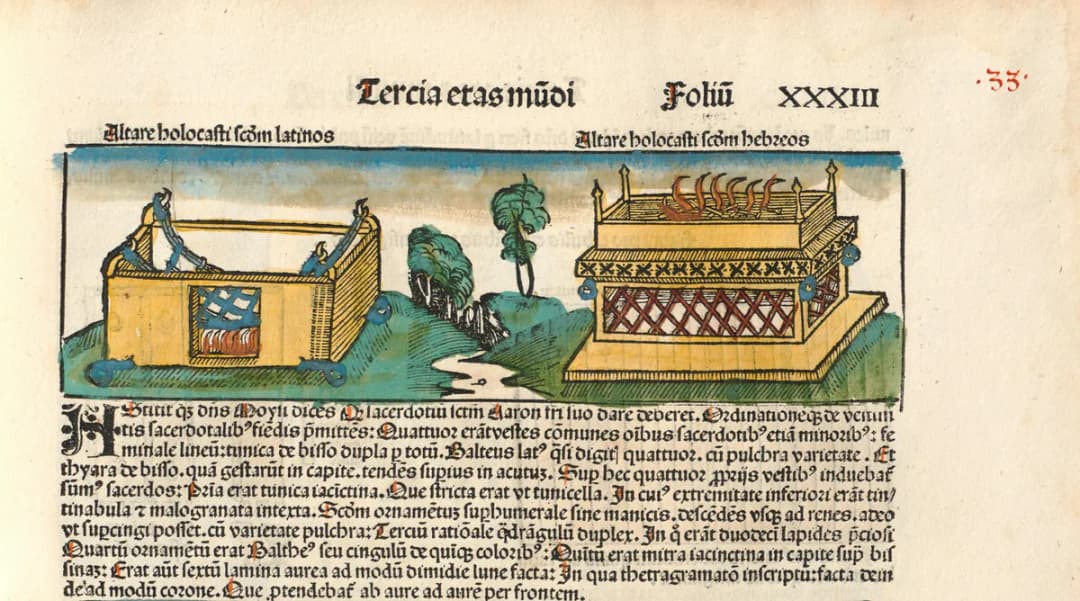
The rabbinical maxim held that 'there is no expiation except by blood,' a principle affirmed in Hebrews. Blood of sacrificial animals was caught by the priest and sprinkled or poured according to the nature of the offering: on the altar's horns or base, before the veil, on the mercy seat on the Day of Atonement, or on the doorposts at Passover. These ceremonies foreshadowed the greater reality to come in Christ's sacrifice.
☩The Blood of Christ
The New Testament presents Christ's blood as the fulfillment of all sacrificial types. His blood was shed for the remission of sins, establishing the new covenant. Through His blood believers are redeemed, justified, sanctified, and cleansed from all sin. His blood purchases the church, brings near those who were far off, makes peace through the cross, and gives boldness to enter the heavenly sanctuary.
☩Blood Guilt and Vengeance
Human bloodshed pollutes the land and cries out for expiation, which can only be made by the blood of the one who shed it. The 'avenger of blood' was the nearest kinsman who was bound to pursue the manslayer. The Mosaic law mitigated private vengeance by establishing cities of refuge for those who killed accidentally, where they could remain safe until the death of the high priest.
Related Verses381 mentions
See Also
References
- 1.John McClintock and James Strong, "Blood," in Cyclopedia of Biblical, Theological and Ecclesiastical Literature, vol. I (Harper & Brothers, 1867–1887).
- 2.James Orr (ed.), "Blood," in International Standard Bible Encyclopedia, vol. I (Howard-Severance Company, 1915).
- 3.George Morrish, "Blood," in Morrish's Concise Bible Dictionary (George Morrish, 1898).
- 4.James Hastings (ed.), "Blood," in Dictionary of the Apostolic Church, vol. I (T. & T. Clark, 1915–1918).