
Linen
Summary
Cloth made from flax, highly valued in the ancient world for its whiteness and purity, used extensively for priestly garments, royal attire, tabernacle furnishings, and burial shrouds.
☩Production and Trade
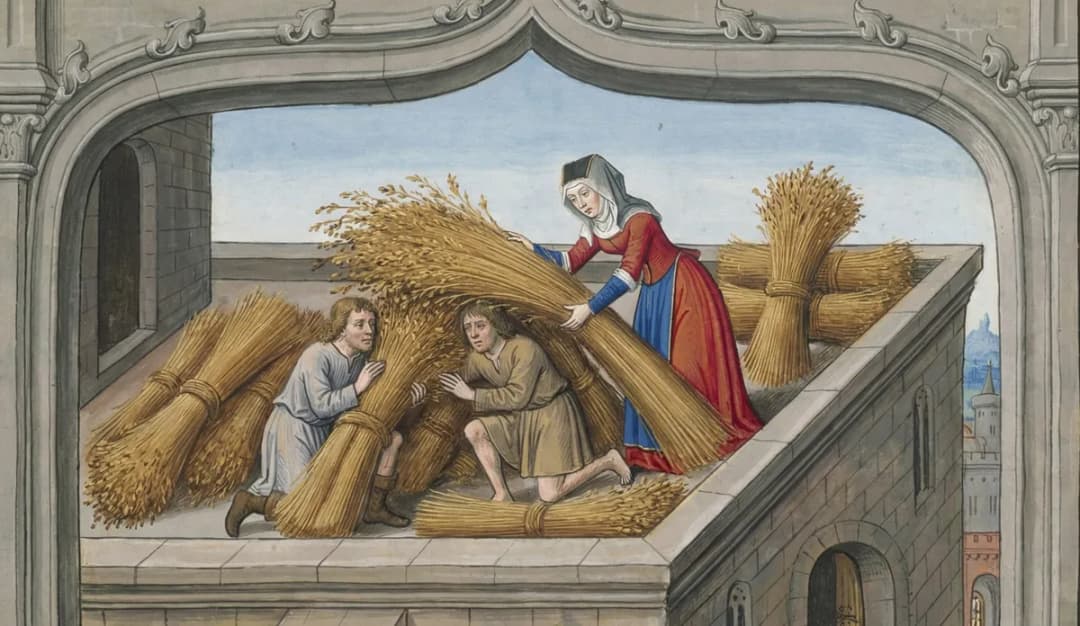
Ancient Egypt was renowned for its fine linen, particularly that made from byssus, a flax growing on the Nile banks. Egyptian linen was exceedingly soft, of dazzling whiteness, and sometimes sold for twice its weight in gold. Sir J.G. Wilkinson noted that Egyptian fine linen was 'comparable to silk' in touch and 'not inferior in texture to our finest cambric.' From Egypt, a large export trade supplied surrounding nations, including Palestine, where spinning was carried on by women as a praiseworthy domestic skill.
☩Sacred and Priestly Use
Linen was the prescribed material for the holy garments of the Levitical priests, consisting of four distinct linen garments. The Hebrew term 'bad' (meaning 'separate' from the distinctness of threads in the texture) was exclusively applied to holy linen garments of priests and angels. Egyptian priests likewise wore linen exclusively, and Herodotus records they wore 'linen garments, constantly fresh washed.' The curtains and hangings of the tabernacle were of fine twisted linen, symbolizing purity in divine worship.
☩Garments of Distinction
Linen garments marked persons of wealth and royal status. Pharaoh arrayed Joseph in fine linen when elevating him to power. The rich man in Jesus' parable was 'clothed in purple and fine linen.' Together with purple, fine linen constituted the characteristic clothing of royalty. However, for ordinary purposes linen probably suggested unbecoming luxury, and poorer classes wore coarser fabrics of unbleached flax or hemp.
☩Burial Customs
The Egyptians used linen exclusively in wrapping their mummies, sometimes using over a hundred yards in one bandage. Microscopic examination has confirmed that mummy cloths are linen, not cotton. Similarly, the Jews preferred linen for burial wrappings. Jesus' body was wrapped in a linen cloth (sindon) when taken from the cross, and bound with linen strips (othonia) along with burial spices. The empty grave cloths became evidence of the resurrection.
☩Symbolic Significance
Fine linen's whiteness made it a natural symbol of purity and righteousness. The seven angels in Revelation are 'arrayed in linen, pure and bright.' The bride of the Lamb is dressed in fine linen, 'bright and pure,' which represents 'the righteous deeds of the saints.' This imagery draws on the ancient association of white linen with priestly holiness, making it fitting that the armies of heaven following Christ are clothed in white linen.
Related Verses90 mentions
References
- 1.James Orr (ed.), "Linen," in International Standard Bible Encyclopedia, vol. III (Howard-Severance Company, 1915).
- 2.F. N. Peloubet & M. A. Peloubet (ed.), "Linen," in Smith's Bible Dictionary (Porter & Coates, 1884).
- 3.Andrew Robert Fausset, "Linen," in The Englishman's Critical and Expository Bible Cyclopædia (Hodder & Stoughton, 1878).
- 4.James Hastings (ed.), "Linen," in Dictionary of Christ and the Gospels, vol. II (T. & T. Clark, 1906–1908).
- 5.George Morrish, "Linen," in Morrish's Concise Bible Dictionary (George Morrish, 1898).