
Jethro
“Excellence or abundance”
Summary
The priest of Midian and father-in-law of Moses, who gave wise counsel regarding the administration of Israel and recognized the supremacy of Yahweh over all gods.
☩Relationship to Moses
When Moses fled from Egypt after killing an Egyptian, he found refuge in Midian where Jethro received him warmly into his household. Moses had shown kindness to Jethro's seven daughters by helping them water their flock at the well, defending them against shepherds who had driven them away. This friendship resulted in Jethro giving his daughter Zipporah to Moses in marriage, and Moses spent approximately forty years in Jethro's service, tending his flocks. It was while keeping Jethro's flock at Horeb that the angel of the Lord appeared to Moses in the burning bush, commissioning him to deliver Israel from Egypt. With Jethro's consent, Moses returned to Egypt to fulfill this divine calling.
☩Visit to Moses at Sinai
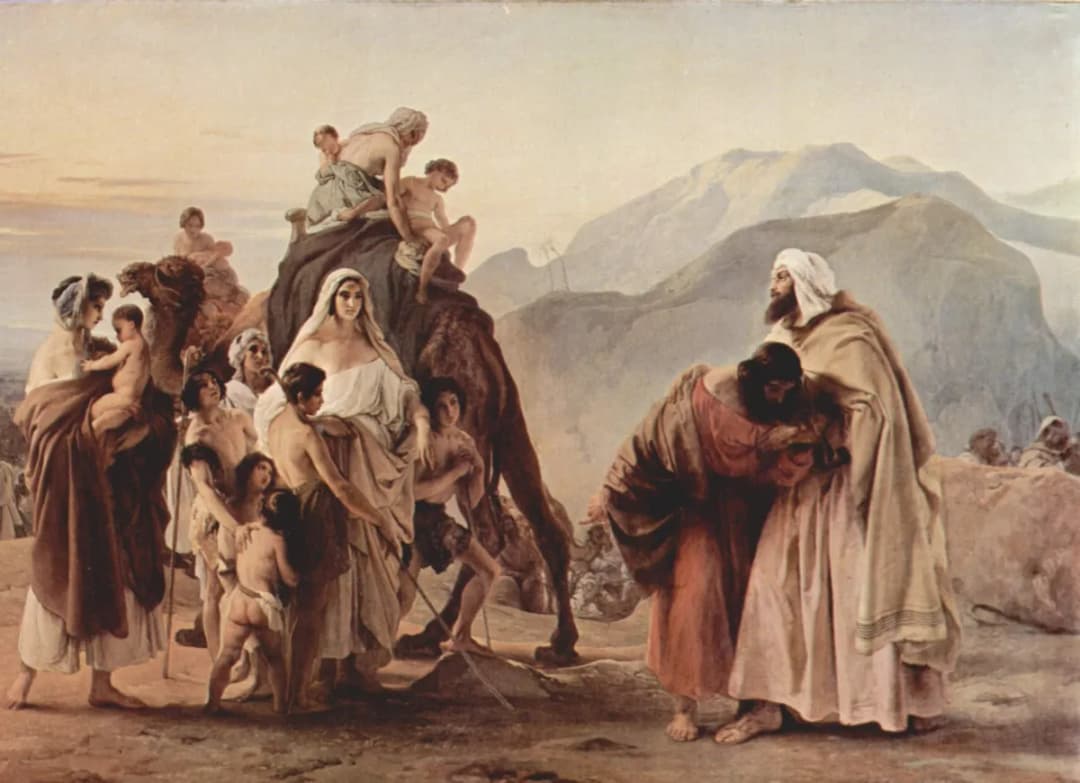
After Israel's exodus from Egypt, when news reached Midian of God's mighty acts for His people, Jethro traveled to visit Moses at the mount of God, bringing Zipporah and their two sons Gershom and Eliezer. Moses went out to meet his father-in-law, bowed before him, and they retired to Moses' tent for a cordial interview. Jethro rejoiced when he heard all the particulars of the great deliverance, declaring, 'Now I know that the LORD is greater than all gods; yea, in the thing wherein they dealt proudly against them.' This confession likely refers to how the Egyptians were overthrown by the very waters through which they presumed to pursue Israel. Jethro then offered burnt offerings and sacrifices to God, and Aaron with all the elders of Israel came to eat bread with him before God—a significant priestly act recognizing worship beyond Israel's boundaries.
☩Counsel on Administration
Jethro's visit had profound consequences for Israel's future governance. Observing Moses occupied from morning to night judging disputes among the people, Jethro warned that this labor would wear out both Moses and the people. He counseled Moses to appoint able men—men who feared God, loved truth, and hated covetousness—as judges over thousands, hundreds, fifties, and tens, reserving only the most difficult cases for Moses himself. Moses recognized the wisdom of this advice and implemented it, establishing a gradation of judicial authority that would ensure all law expressed the divine will while entrusting its application to qualified leaders. This wise counsel taught the vital distinction between legislative and judicial functions. Afterward, Jethro returned to his own country.
☩Names and Identity
The relationship between Jethro, Reuel, and Hobab presents interpretive challenges. In Exodus 2:18, Moses' father-in-law appears to be called Reuel, while Exodus 3:1 calls him Jethro, the priest of Midian. Numbers 10:29 mentions Hobab, son of Raguel (Reuel) the Midianite, as Moses' father-in-law, which may indicate Reuel was the grandfather and Hobab the actual father-in-law—with Jethro being an official title rather than a personal name. Alternatively, some scholars insert 'Jethro son of' before Reuel in Exodus 2:18, making Jethro and Hobab the same person. Though called a Midianite in Exodus, Moses' father-in-law is termed a Kenite in Judges 1:16 and 4:11, suggesting the Midianites and Kenites were intimately blended at that time.
References
- 1.James Orr (ed.), "Jethro," in International Standard Bible Encyclopedia, vol. III (Howard-Severance Company, 1915).
- 2.George Morrish, "Jethro," in Morrish's Concise Bible Dictionary (George Morrish, 1898).