
Tradition
“A giving over, handing down”
Summary
Tradition (Greek _paradosis_) refers to teachings handed down orally from generation to generation, which in Jewish theology came to be regarded as equal or even superior to the written Law.
☩Jewish Oral Tradition
The Jews maintained that besides the written Law in the Pentateuch, God delivered to Moses an oral law that was handed down from generation to generation. This oral Torah comprised legal decisions (_Halakhoth_), narrative embellishments (_Haggadoth_), and interpretations of the Law (_Midrashim_). The Pharisees asserted that the oral law possessed equal or even greater authority than the written Law, claiming it traced back through an unbroken chain: Moses to Joshua to the elders to the prophets to the men of the Great Synagogue. The Sadducees, by contrast, rejected these claims entirely. The oral traditions were eventually committed to writing in the Mishna (c. AD 200), and expanded further in the Talmud.
☩Christ's Condemnation of Human Tradition
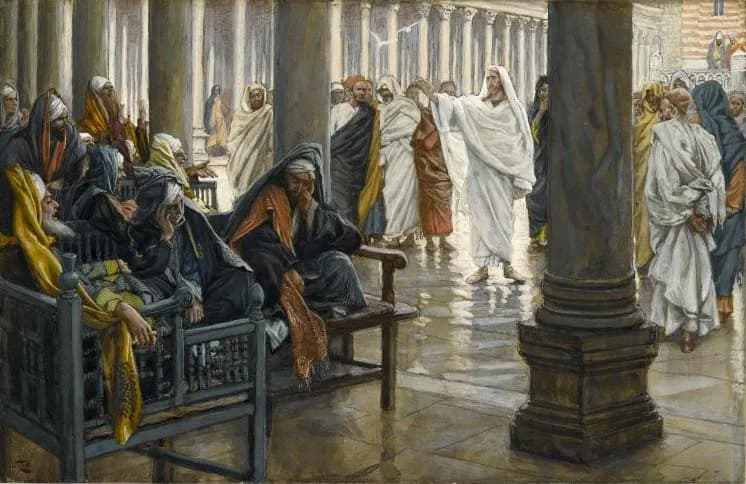
Jesus strongly rebuked the Pharisees for their adherence to human traditions that contradicted or nullified God's commandments. He charged them with 'making the commandment of God of none effect through your tradition.' Examples included the practice of 'Corban,' by which a person could dedicate property to the Temple and thereby avoid the obligation to support aging parents, directly violating the fifth commandment. Jesus also challenged their ceremonial traditions about hand washing, teaching that true defilement comes from the heart, not from external contact with unwashed hands or vessels. He classified such traditions as 'commandments of men' and mere 'lip-service' rather than genuine worship.
☩Apostolic Tradition
The Greek word _paradosis_ has both positive and negative uses in the New Testament. In three passages, it refers positively to apostolic teaching delivered to the churches: Paul commends the Corinthians for keeping the traditions he delivered and instructs the Thessalonians to hold fast to traditions received by word or epistle.[2,6] These apostolic traditions, however, were inspired instruction later embodied in canonical Scripture, not supplementary human additions. In contrast, ten passages use 'tradition' negatively to describe the uninspired teachings of men. The apostles never appeal to human tradition but always to Scripture, establishing the principle that inspired written revelation is the sole authoritative standard for faith and practice.
Related Verses18 mentions
See Also
References
- 1.John McClintock and James Strong, "Tradition," in Cyclopedia of Biblical, Theological and Ecclesiastical Literature, vol. X (Harper & Brothers, 1867–1887).
- 2.James Orr (ed.), "Tradition," in International Standard Bible Encyclopedia, vol. V (Howard-Severance Company, 1915).
- 3.James Hastings (ed.), "Tradition," in Dictionary of the Apostolic Church, vol. II (T. & T. Clark, 1915–1918).
- 4.James Hastings (ed.), "Tradition," in Dictionary of Christ and the Gospels, vol. II (T. & T. Clark, 1906–1908).
- 5.George Morrish, "Tradition," in Morrish's Concise Bible Dictionary (George Morrish, 1898).
- 6.Andrew Robert Fausset, "Tradition," in The Englishman's Critical and Expository Bible Cyclopædia (Hodder & Stoughton, 1878).