
Apostle
“One sent forth, an envoy or delegate”
Summary
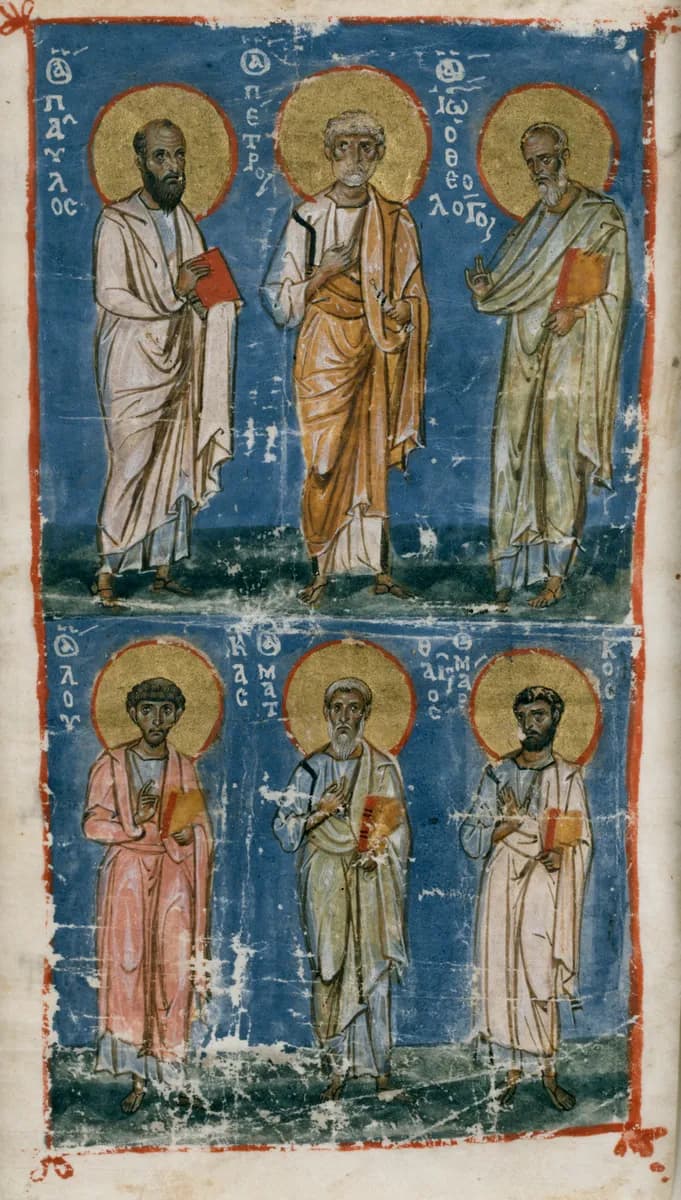
One sent forth with a commission, specifically the twelve disciples chosen by Jesus to be witnesses of His resurrection and to found and govern His Church, later including Paul who received a direct commission from the risen Christ.
☩Selection and Commission
Jesus chose twelve from among His disciples, naming them apostles, that they might be with Him and that He might send them forth to preach and exercise authority over demons. Their names were Simon Peter, Andrew, James and John (sons of Zebedee), Philip, Bartholomew (Nathanael), Thomas, Matthew, James son of Alphaeus, Thaddaeus (also called Lebbaeus or Judas), Simon the Zealot, and Judas Iscariot. To them Jesus gave the keys of the kingdom, constituting them princes over spiritual Israel. After His resurrection He confirmed their commission: 'As the Father has sent me, even so I send you.'
☩Qualifications and Authority
The essential qualification for apostleship was having been a witness of Jesus' ministry from His baptism through His resurrection, enabling them to testify firsthand to what they had seen and heard. At Pentecost they received the promised Holy Spirit, who brought all things to their remembrance and guided them into all truth. Their authority was recognized as binding in heaven: what they bound or loosed on earth would be bound or loosed in heaven. Their infallibility in teaching, attested by miracles, marked them as extraordinary ministers whose office could not be permanently continued.
☩Paul's Apostleship
Paul claimed full apostolic authority, not received from men but through direct revelation of Jesus Christ. He defended this claim on three grounds: he had seen the risen Lord, he had received a personal call to the apostolic office, and his missionary labors bore the unmistakable seals of genuine apostleship. The original apostles, perceiving the grace given to him, recognized Paul as apostle to the Gentiles and gave him the right hand of fellowship. Though he was 'untimely born' and had persecuted the Church, he labored more abundantly than all the others.
☩Wider Usage and Limitations
The term 'apostle' appears in broader senses in the New Testament: Barnabas is called an apostle alongside Paul, messengers of churches are termed 'apostles of the churches,' and Jesus Himself is called 'the Apostle of our confession.' However, in its technical sense, apostleship was restricted to those personally commissioned by Christ, who were qualified to be witnesses of His resurrection. Since the apostles' unique office was to found the Church on the foundation of Christ, they could have no successors; to be an apostle one must have 'seen the Lord.'
Related Verses77 mentions

References
- 1.John McClintock and James Strong, "Apostle," in Cyclopedia of Biblical, Theological and Ecclesiastical Literature, vol. I (Harper & Brothers, 1867–1887).
- 2.James Orr (ed.), "Apostle," in International Standard Bible Encyclopedia, vol. I (Howard-Severance Company, 1915).
- 3.James Hastings (ed.), "Apostle," in Dictionary of the Apostolic Church, vol. I (T. & T. Clark, 1915–1918).
- 4.George Morrish, "Apostle," in Morrish's Concise Bible Dictionary (George Morrish, 1898).
- 5.Andrew Robert Fausset, "Apostle," in The Englishman's Critical and Expository Bible Cyclopædia (Hodder & Stoughton, 1878).