
Law(moral law, mosaic law)
Summary
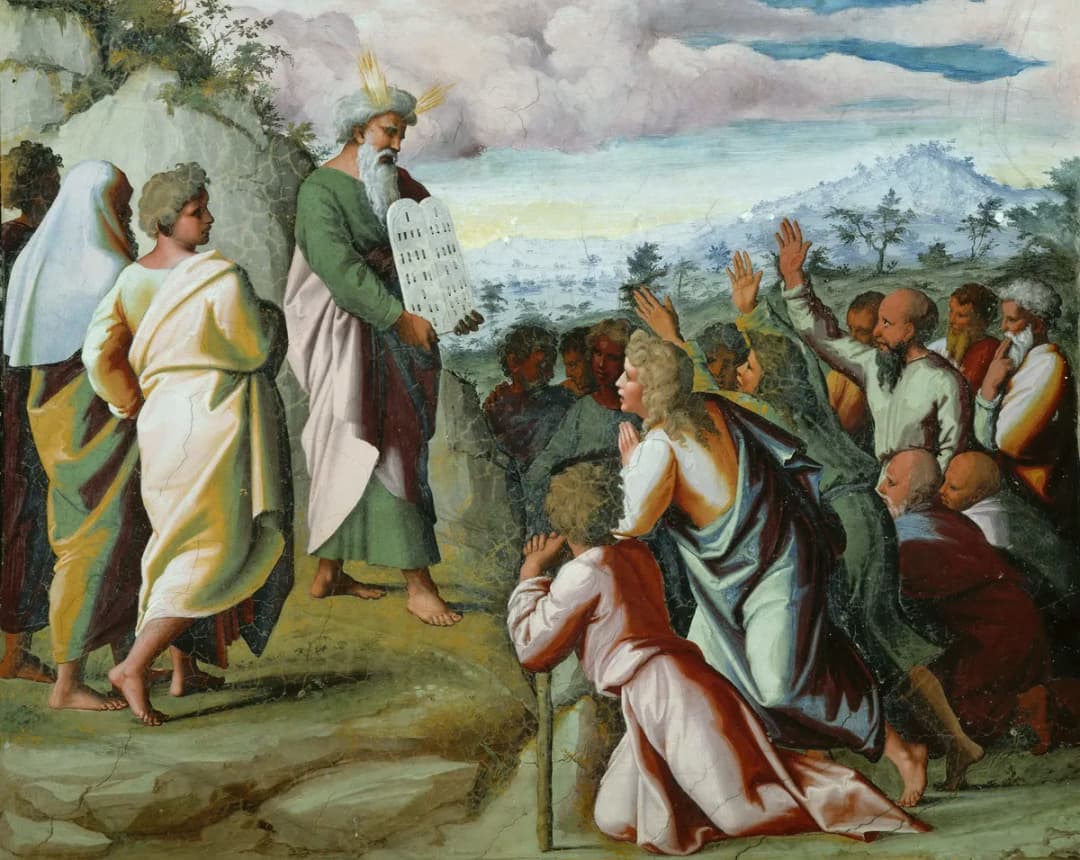
The authoritative expression of God's will given to His people, most notably through Moses at Sinai, encompassing moral, ceremonial, and civil prescriptions that governed Israel's relationship with God and with one another.
☩Definition and Scope
The term 'law' (Hebrew torah, Greek nomos) properly signifies a rule or directive from a superior authority that an inferior is bound to obey. When used with the article, it generally refers to the Mosaic law or the Pentateuch, though occasionally it designates the entire Old Testament. The Hebrew torah emphasizes moral authority as teaching truth and guiding in the right way, while the Greek nomos stresses constraining power as imposed and enforced by recognized authority. Paul extends the term to include any power acting on the will by compulsion or external motives.
☩Categories of Law
Biblical law encompasses several distinct categories. The moral law, summarized in the Decalogue, declares God's unchangeable will binding all people in every age, reflecting His eternal character. The ceremonial law prescribed Israel's worship rituals, which were typical of Christ and remained obligatory until His finished work. The civil or judicial law directed the Hebrew nation's political life under God's direct rule as their supreme magistrate. The law of nature is God's will discoverable by natural light and written on human conscience, binding all mankind.
☩Christ and the Law
Jesus affirmed the authority and permanence of the law, declaring that not one jot or tittle would pass away until all was fulfilled. He did not oppose the law itself but exposed the inadequacy of traditional interpretations that reduced its demands to mere external conformity. Christ revealed the law's full spiritual meaning: anger violates the command against murder, and lust violates the prohibition of adultery. He epitomized the entire law in the two great commandments: love God with all your heart, and love your neighbor as yourself.
☩The Law and the Gospel
Paul teaches that the law, though holy and good, cannot justify sinners because of the weakness of human flesh. The law was added because of transgressions, to make sin evident and lead people to recognize their need for the promised Savior. It served as a guardian or schoolmaster to bring humanity to Christ. Believers are no longer under law as a covenant of works or source of terror, but the law remains as a rule of conduct and a revelation of God's holy character. Love fulfills the law, for all commandments are comprehended in loving one's neighbor as oneself.
Related Verses544 mentions
See Also


References
- 1.John McClintock and James Strong, "Law," in Cyclopedia of Biblical, Theological and Ecclesiastical Literature, vol. V (Harper & Brothers, 1867–1887).
- 2.F. N. Peloubet & M. A. Peloubet (ed.), "Law," in Smith's Bible Dictionary (Porter & Coates, 1884).
- 3.James Orr (ed.), "Law in the New Testament," in International Standard Bible Encyclopedia, vol. III (Howard-Severance Company, 1915).
- 4.George Morrish, "Law," in Morrish's Concise Bible Dictionary (George Morrish, 1898).