
Moon
Summary
The moon was created by God as the 'lesser light' to rule the night, served as the basis for Israel's calendar and festivals, and was worshiped by surrounding nations though forbidden to Israel.
☩Creation and Purpose
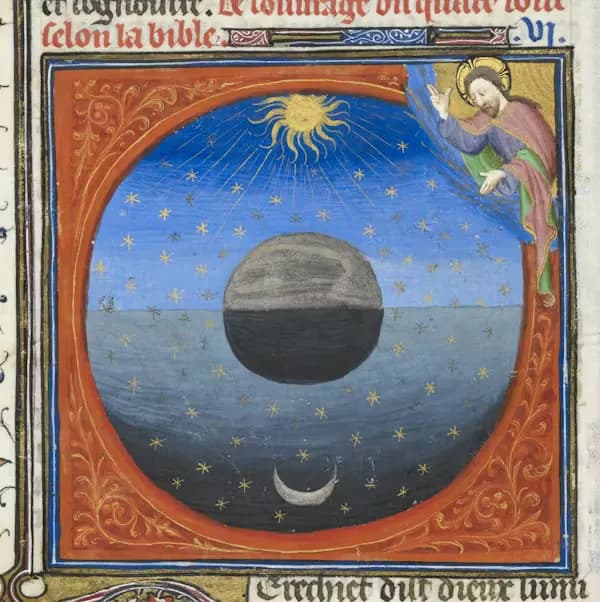
The moon was created on the fourth day along with the sun and stars, appointed 'for signs and for seasons, and for days and years.' It exercised an especially important influence in determining the religious festivals of the Jews, as stated in Psalm 104:19: 'He appointed the moon for seasons.' The Hebrew calendar was lunar, with months beginning at the new moon and major festivals often tied to lunar phases—the Passover, for example, always fell at full moon on the 14th of Nisan. The brightness of the moon in Eastern lands made it far more prominent than in Western countries, guiding travelers by night when the day's heat had passed.
☩The New Moon Festival
The appearance of the new moon was a festival among the Israelites, ushered in by the sounding of trumpets. Offerings were prescribed for this occasion, and the day was observed with cessation of ordinary business. Trade was suspended during the new moon celebration, as indicated by the merchants' complaint in Amos: 'When will the new moon be gone, that we may sell grain?' This monthly observance reminded Israel of their dependence on God's ordering of time and seasons.
☩Moon Worship Forbidden
The nations surrounding Israel worshiped the moon extensively under various names: as Isis in Egypt, as Astarte or the 'Queen of Heaven' in Syria and Canaan, and as Sin, 'lord of the month,' in Babylon. Moses warned Israel against being drawn into worship of the heavenly bodies, and Job protested his innocence of such idolatry. Nevertheless, Israel repeatedly fell into moon worship, which was practiced during the reigns of wicked kings and specifically condemned by the prophets. Josiah's reforms included putting down those who burned incense to the moon.
☩Prophetic Symbolism
The darkening or discoloration of the moon appears throughout Scripture as a sign of divine judgment and eschatological upheaval. Joel prophesied that the moon would be turned to blood before the great and terrible day of the Lord, a prophecy cited by Peter at Pentecost. Jesus predicted that at His return 'the moon shall not give her light.' In Revelation, the moon appears under the feet of the woman clothed with the sun, symbolizing either the church's exalted position or the subordination of the old covenant to the new.
Related Verses69 mentions
References
- 1.John McClintock and James Strong, "Moon," in Cyclopedia of Biblical, Theological and Ecclesiastical Literature, vol. VI (Harper & Brothers, 1867–1887).
- 2.James Orr (ed.), "Moon," in International Standard Bible Encyclopedia, vol. III (Howard-Severance Company, 1915).
- 3.James Hastings (ed.), "Moon," in Dictionary of Christ and the Gospels, vol. II (T. & T. Clark, 1906–1908).
- 4.George Morrish, "Moon," in Morrish's Concise Bible Dictionary (George Morrish, 1898).
- 5.F. N. Peloubet & M. A. Peloubet (ed.), "Moon," in Smith's Bible Dictionary (Porter & Coates, 1884).