
Noah
“Rest or comfort”
Summary
Noah was the tenth patriarch from Adam in the line of Seth, a righteous man who found favor with God and was preserved with his family through the great flood by building an ark according to divine instruction.
☩Character and Times
Noah was the son of Lamech and grandson of Methuselah, the tenth and last of the lineage of Seth before the flood. His name means 'rest' or 'comfort,' and Lamech named him thus in allusion to the promised deliverer from sin, saying, 'This same shall comfort us concerning our work and toil of our hands.' In marked contrast to the universal corruption of his age, Noah was a just man, perfect in his generations, and he walked with God. He is the first person in Scripture who is expressly called righteous. During the 120 years before the flood, Noah was a 'preacher of righteousness,' warning his generation of coming judgment.
☩The Ark and the Flood
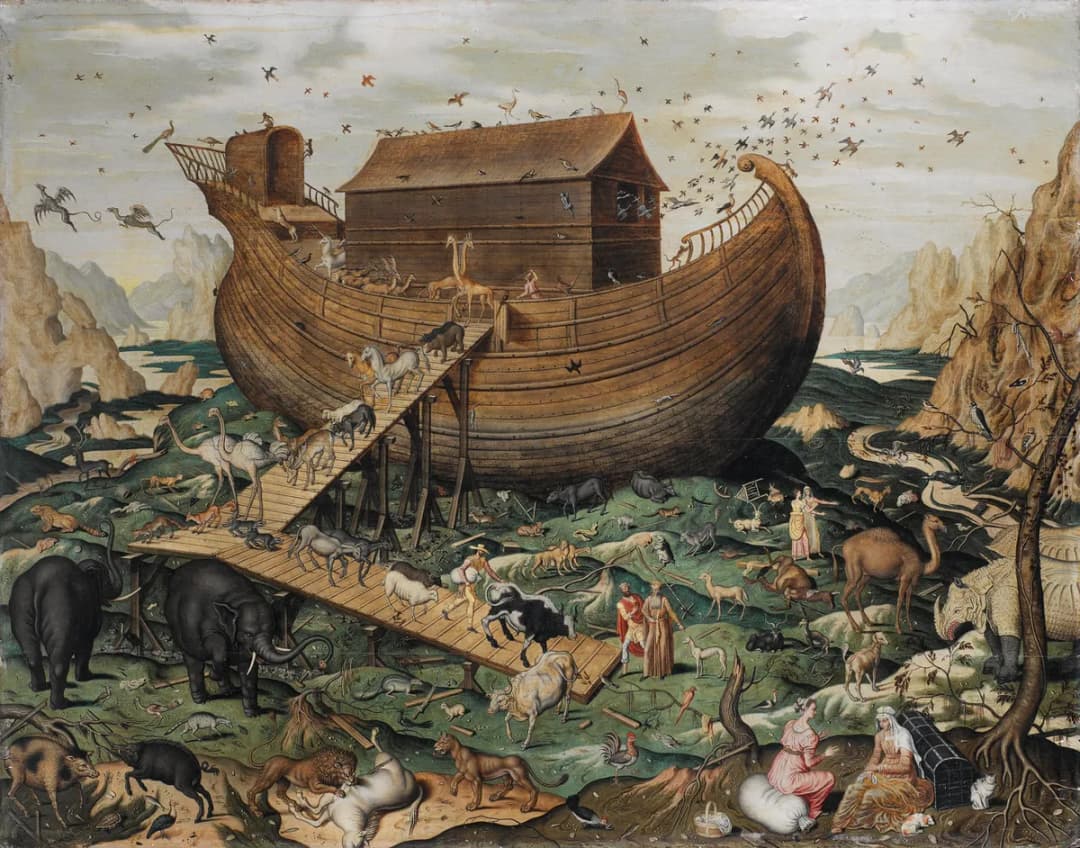
When God determined to destroy the corrupt world, He commanded Noah to build an ark of gopher (cypress) wood, with rooms or compartments for the animals and their food, coated with pitch inside and outside. The ark was 300 cubits long, 50 cubits wide, and 30 cubits high (approximately 525 feet by 87 feet by 52 feet). It was not a ship in the proper sense but an enormous floating structure without mast, sail, or rudder. Noah entered the ark with his wife, his three sons Shem, Ham, and Japheth, and their wives—eight souls in all. The flood came when Noah was 600 years old, and the waters prevailed upon the earth for 150 days before subsiding.
☩Covenant and Sacrifice
Noah's first act after leaving the ark was to build an altar and offer burnt offerings of every clean beast and fowl—the first altar and burnt sacrifice recorded in Scripture. The Lord smelled the pleasing aroma and said in His heart that He would never again curse the ground for man's sake, nor again destroy every living thing as He had done. God established His covenant with Noah and all living creatures, setting the rainbow in the cloud as its sign. This covenant included the blessing to be fruitful and multiply, dominion over the animals, permission to eat meat (but not blood), and the institution of capital punishment for murder.
☩Later Life
After the flood, Noah became a farmer and planted a vineyard. In an incident that marred his otherwise righteous life, he became drunk from the wine and lay uncovered in his tent. His son Ham saw his nakedness and told his brothers, but Shem and Japheth respectfully covered their father without looking upon him. When Noah awoke, he pronounced a curse upon Canaan, Ham's son, and blessings upon Shem and Japheth—prophecies that were fulfilled in subsequent history when Israel conquered the Canaanites. Noah lived 350 years after the flood and died at the age of 950.
☩New Testament References
Jesus used the days of Noah to illustrate the sudden and unexpected coming of the Son of Man, noting that people were eating, drinking, and marrying until the day Noah entered the ark, oblivious to the coming judgment. The writer of Hebrews commends Noah as a hero of faith who, being divinely warned of things not yet seen, moved with godly fear to prepare an ark, thereby condemning the world and becoming heir of the righteousness which is by faith. Peter mentions Noah as preserved through the flood, a type of salvation through baptism.
Related Verses55 mentions
See Also
References
- 1.John McClintock and James Strong, "Noah," in Cyclopedia of Biblical, Theological and Ecclesiastical Literature, vol. VII (Harper & Brothers, 1867–1887).
- 2.James Orr (ed.), "Noah (1)," in International Standard Bible Encyclopedia, vol. IV (Howard-Severance Company, 1915).
- 3.James Hastings (ed.), "Noah," in Dictionary of the Apostolic Church, vol. II (T. & T. Clark, 1915–1918).
- 4.F. N. Peloubet & M. A. Peloubet (ed.), "Noah," in Smith's Bible Dictionary (Porter & Coates, 1884).
- 5.George Morrish, "Noah," in Morrish's Concise Bible Dictionary (George Morrish, 1898).
- 6.James Hastings (ed.), "Noah," in Dictionary of Christ and the Gospels, vol. II (T. & T. Clark, 1906–1908).