
Noah's Ark
“Chest or vessel for floating; from Egyptian 'teb' meaning chest, with no Semitic equivalent”
Summary
The massive vessel of gopher wood that God commanded Noah to build, which preserved his family and representatives of every animal kind through the worldwide Flood.
☩The Divine Command
When God resolved to destroy all flesh because of the corruption and violence that filled the earth, He commanded Noah—the one righteous man of his generation—to build an ark for the preservation of his household and of every kind of living creature. The Hebrew word tebah, used only for this vessel and for the basket of bulrushes in which the infant Moses was placed, denotes something designed to float rather than navigate, a vessel entrusted entirely to the providence of God. Noah's obedience in building the ark over many years, despite the absence of any visible threat, is held up in Scripture as a supreme example of faith.
☩Construction and Dimensions
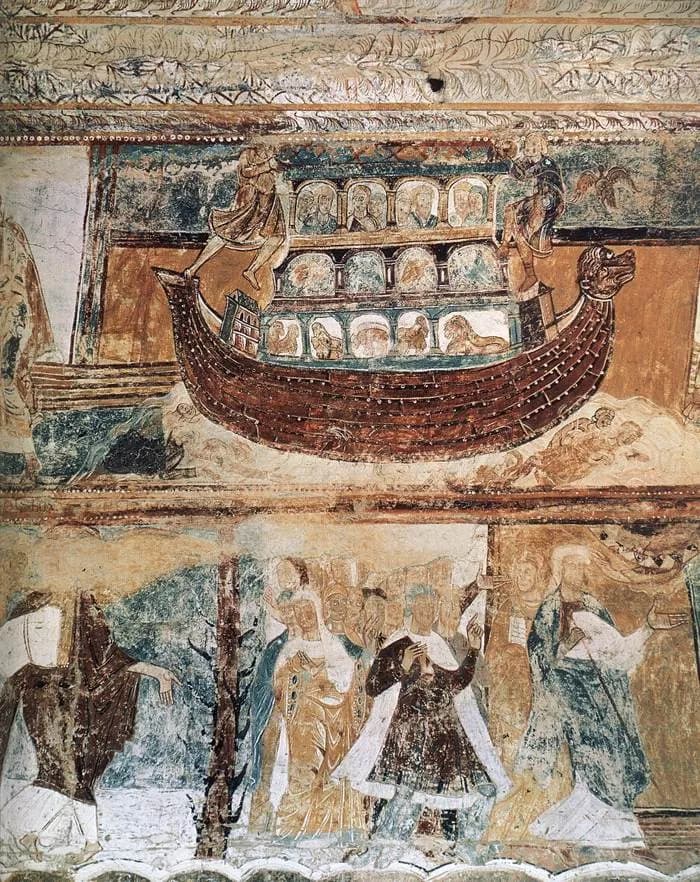
The ark was built of gopher wood (likely cypress) and waterproofed with pitch inside and out. Its dimensions were approximately 450 feet long, 75 feet wide, and 45 feet high—three hundred cubits by fifty by thirty—with three decks, a door in the side, and an opening above for light and ventilation. These proportions give a vessel of roughly 1.5 million cubic feet, with a length-to-beam ratio of 6:1 that favours stability over navigation—consistent with a vessel designed to float, not to sail. The scale was sufficient to house Noah's family of eight persons, pairs of every animal kind, and seven pairs of every clean animal designated for sacrifice and food.
☩The Flood and Preservation
When Noah, his wife, his three sons, and their wives had entered with all the animals, the Lord shut the door behind them. The fountains of the great deep burst open and the windows of heaven were opened, and rain fell for forty days and forty nights until the waters covered every high mountain. The ark floated on the surface for roughly a year until it came to rest on the mountains of Ararat. Noah sent out a raven and then a dove at intervals to test whether the waters had receded; when the dove returned with a fresh olive leaf, he knew the earth was drying. God then commanded Noah to leave the ark, and Noah's first act was to build an altar and offer burnt offerings of the clean animals, upon which God established His covenant never again to destroy the earth by flood.
☩Typological Significance
Noah's ark is a prominent type of salvation in Christ: as the ark preserved through the waters of divine judgment all who entered by the one door, so Christ saves from the wrath to come all who enter through Him. Peter explicitly connects baptism to the ark, declaring that the eight souls saved through water prefigured the believer's salvation. Jesus Himself drew a parallel between the days of Noah and His own return, warning that the world will again be caught unprepared by sudden judgment.
Related Verses31 mentions
See Also
References
- 1.John McClintock and James Strong, "Ark," in Cyclopedia of Biblical, Theological and Ecclesiastical Literature, vol. I (Harper & Brothers, 1867–1887).
- 2.Andrew Robert Fausset, "Ark," in The Englishman's Critical and Expository Bible Cyclopædia (Hodder & Stoughton, 1878).