
Cross
“Stake, cross”
Summary
The instrument of crucifixion upon which Jesus Christ was executed, becoming the central symbol of Christian faith representing Christ's atoning death and victory over sin.
☩Form and Construction
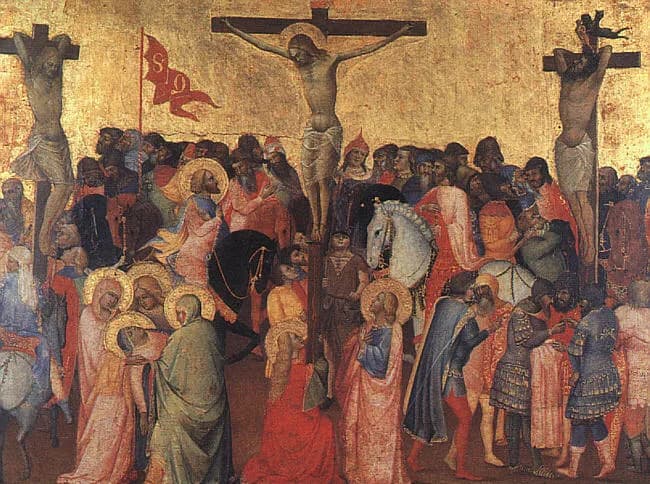
The Greek word 'stauros' originally denoted an upright pale or stake, but in New Testament usage it refers to a cross consisting of a vertical beam (staticulum) and a horizontal crossbar (patibulum). The most common form used for crucifixion was the 'crux immissa' or Latin cross, where the upright beam extended above the crossbar. The condemned person typically carried only the crossbar (patibulum) to the place of execution, where it was affixed to the already-planted vertical beam. A small wooden projection (sedile) sometimes supported the body's weight, while the feet rested on a small platform (suppedaneum).
☩Crucifixion as Roman Punishment
Crucifixion was considered the most shameful and agonizing form of death in the Roman world, reserved primarily for slaves, criminals, and enemies of the state. The victim was stripped naked and either bound or nailed to the cross, with death resulting from exhaustion, exposure, and asphyxiation over many hours or even days. Roman citizens were exempt from this punishment except in cases of high treason. The Jews considered one who hung on a tree to be under God's curse (Deuteronomy 21:23), adding religious disgrace to the physical agony.
☩Theological Significance
The cross became the supreme symbol of Christ's redemptive work, where He bore the sins of humanity and reconciled the world to God. Paul declared that he gloried only in the cross, through which he was crucified to the world (Galatians 6:14). The 'word of the cross' appeared as foolishness to the perishing but as the power of God to those being saved (1 Corinthians 1:18). Christ's death on the cross abolished the enmity between Jew and Gentile, creating one new humanity, and triumphed over principalities and powers.
☩Taking Up the Cross
Jesus called His disciples to deny themselves and take up their cross daily to follow Him (Luke 9:23). This metaphor signified complete surrender of self-will and readiness to suffer reproach for Christ's sake. The early Christians understood this call as embracing persecution, loss, and even death for their faith. Those who were ashamed of Christ and His words would find the Son of Man ashamed of them at His coming.
Related Verses34 mentions
See Also

References
- 1.John McClintock and James Strong, "Cross," in Cyclopedia of Biblical, Theological and Ecclesiastical Literature, vol. II (Harper & Brothers, 1867–1887).
- 2.James Orr (ed.), "Cross," in International Standard Bible Encyclopedia (Howard-Severance Company, 1915).
- 3.George Morrish, "Cross," in Morrish's Concise Bible Dictionary (George Morrish, 1898).