
Golgotha
“Skull”
Summary
The Aramaic name for the place where Jesus Christ was crucified, translated as 'the place of a skull,' also known by its Latin equivalent Calvary.
☩Name and Meaning
Golgotha is the Greek transliteration of the Aramaic Gulgalta, meaning 'skull.' Three of the evangelists use this name and interpret it as 'the place of a skull.' Luke uses the Greek equivalent Kranion, which the Latin Vulgate rendered Calvaria, from which we derive 'Calvary.' Three explanations for the name have been proposed: an ancient tradition that Adam was buried there, that it was a place of execution where skulls were found, or that the site itself had a skull-like contour.
☩Biblical Information
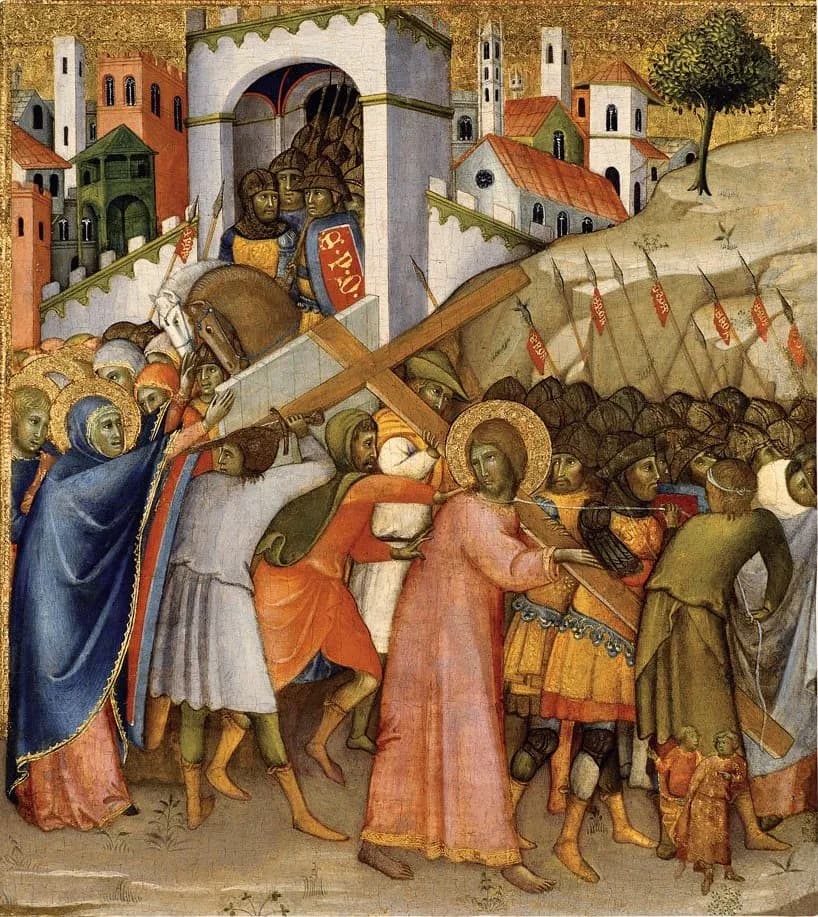
Scripture provides limited but significant details about Golgotha's location. It was outside the city gate but near to Jerusalem. It was apparently beside a public thoroughfare where passersby could observe and mock the crucified. The site was visible from some distance. Near the place of crucifixion was a garden containing a new tomb hewn from rock, belonging to Joseph of Arimathea, where Jesus was buried.
☩Historical Site
Neither Golgotha nor the tomb is mentioned again by the apostolic writers, and no special honor appears to have been attached to them in the earliest period of church history. In the fourth century, Emperor Constantine, reportedly guided by divine indication, ordered the site uncovered and discovered what was believed to be the holy tomb beneath a pagan temple. A magnificent church was built and consecrated in AD 335. The Church of the Holy Sepulchre today is generally believed to occupy this same location, though some scholars propose alternative sites.
See Also
References
- 1.John McClintock and James Strong, "Golgotha," in Cyclopedia of Biblical, Theological and Ecclesiastical Literature, vol. III (Harper & Brothers, 1867–1887).
- 2.James Orr (ed.), "Golgotha," in International Standard Bible Encyclopedia, vol. II (Howard-Severance Company, 1915).
- 3.James Hastings (ed.), "Golgotha," in Dictionary of Christ and the Gospels, vol. I (T. & T. Clark, 1906–1908).