
Hospitality
“From Greek philoxenia, meaning love of strangers”
Summary
Hospitality is the practice of receiving and entertaining strangers, regarded as one of the chief virtues in the ancient East and expressly enjoined in both Old and New Testaments as reflecting the character of God Himself.
☩Hospitality in the Ancient East
Hospitality has nowhere been earlier or more fully practiced than in the East. Among the Arabs to this day, an arriving traveler says to his host, 'I am your guest,' and the host receives him, providing supper and care for his animals. If unacquainted with anyone, the stranger alights at any house, fastens his horse, and smokes his pipe until the master bids him welcome. The early existence and long continuance of this practice are due to conditions necessitating such kindness—where population is thinly scattered and inns are not found, the traveler needs shelter, and pity prompts the householder to open his door.
☩Old Testament Commands and Examples
The Jewish laws respecting strangers and the poor are framed in accordance with the spirit of hospitality. Compassion to strangers is constantly enforced by the reminder, 'For ye were strangers in the land of Egypt.' Abraham's entertainment of the three angels, Lot's reception of visitors, Reuel's welcoming of Moses, and Manoah's hospitality exemplify these precepts. The guest was furnished with water to wash his feet, received food for himself and his beast, and enjoyed courtesy and protection from his host. The covenant of salt established an inviolable bond between host and guest.
☩New Testament Teaching
The apostles urged the church to 'follow after hospitality,' to remember Abraham's example of entertaining angels unawares, and to 'use hospitality one to another without grudging.' A bishop must be a 'lover of hospitality.' Jesus identified Himself with the stranger: 'I was a stranger and ye took me in' would be the commendation of the righteous at the Last Judgment, while 'I was a stranger and ye took me not in' would condemn the unrighteous. Two disciples at Emmaus 'constrained' Jesus to abide with them, and in the breaking of bread their eyes were opened.
☩Hospitality in the Early Church
Hospitality was vital to the very existence of the early Christian church. The ordinary ties of friendship had in many cases been severed, and Christians regarded themselves as members of one family. Whenever a Christian migrated, he was to be received as a welcome guest by Christians residing there; without such hospitality missionary work would have been impossible. Paul commends Phoebe who had been a 'succourer of many,' Gaius who was 'host to the whole church,' and Onesiphorus who 'oft refreshed' him. Third John commends Gaius for receiving traveling brethren.
☩Customs of Hospitality
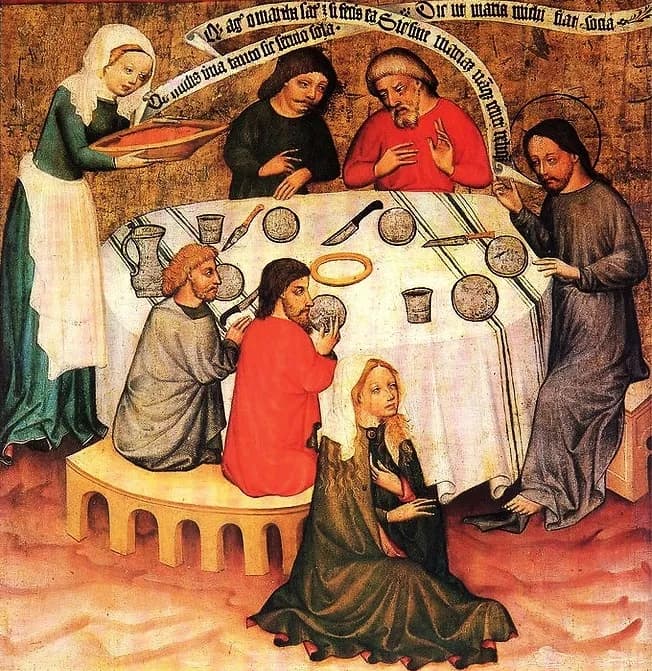
The washing of a guest's feet by the host was a mark of honor to the guest and deep humility on the part of the host—hence the significance of Jesus washing the disciples' feet and Simon the Pharisee's failure to provide water for Jesus' feet. Kissing was another act of courtesy usually accorded to distinguished guests. In Palestine today, the guest is regarded as 'lord' of the house for three days; during his sojourn his person is inviolable, even if he be the sworn enemy of his host. The proverbs express the binding nature of this virtue: 'Every stranger is an invited guest.'
Related Verses60 mentions

References
- 1.John McClintock and James Strong, "Hospitality," in Cyclopedia of Biblical, Theological and Ecclesiastical Literature, vol. IV (Harper & Brothers, 1867–1887).
- 2.F. N. Peloubet & M. A. Peloubet (ed.), "Hospitality," in Smith's Bible Dictionary (Porter & Coates, 1884).
- 3.George Morrish, "Hospitality," in Morrish's Concise Bible Dictionary (George Morrish, 1898).
- 4.James Hastings (ed.), "Hospitality," in Dictionary of Christ and the Gospels, vol. I (T. & T. Clark, 1906–1908).
- 5.James Hastings (ed.), "Hospitality," in Dictionary of the Apostolic Church, vol. I (T. & T. Clark, 1915–1918).