
Ephraim(ephraimites)
“Doubly fruitful”
Summary
The younger son of Joseph whom Jacob elevated above his elder brother Manasseh, founder of a powerful tribe that became synonymous with the northern kingdom of Israel.
☩The Patriarch
Ephraim was the younger of Joseph's two sons by Asenath, daughter of Potipherah, born during the seven years of plenty in Egypt. Joseph named him Ephraim, meaning 'doubly fruitful,' saying 'God hath caused me to be fruitful in the land of my affliction.' When Jacob blessed his grandsons, he deliberately crossed his hands to place his right hand on the younger Ephraim's head despite Joseph's protest, declaring that while Manasseh would become a great people, the younger brother would be greater and his seed would become a 'multitude of nations.' By this adoptive blessing, Ephraim and Manasseh were counted as sons of Jacob, giving Joseph a double portion through his children. Ephraim was about twenty-one years old when Jacob blessed him, and before Joseph's death his descendants had reached the third generation.
☩The Tribe
At the first census in the wilderness, Ephraim numbered 40,500 fighting men, but by the second census this had decreased to 32,500—the only tribe smaller being Simeon. Despite this decline in numbers, Moses' blessing confirmed Ephraim's pre-eminence, comparing Joseph's descendants to the horns of the wild ox pushing the people to the ends of the earth, with 'the ten thousands of Ephraim' set above 'the thousands of Manasseh.' Joshua, the tribe's most illustrious son, led Israel into Canaan and became the representative of Ephraim's importance. The tribe's proud spirit showed early: they rebuked Gideon for not summoning them sooner to battle, and their quarrel with Jephthah resulted in 42,000 Ephraimites being slain at the Jordan fords.
☩Territory and Significance
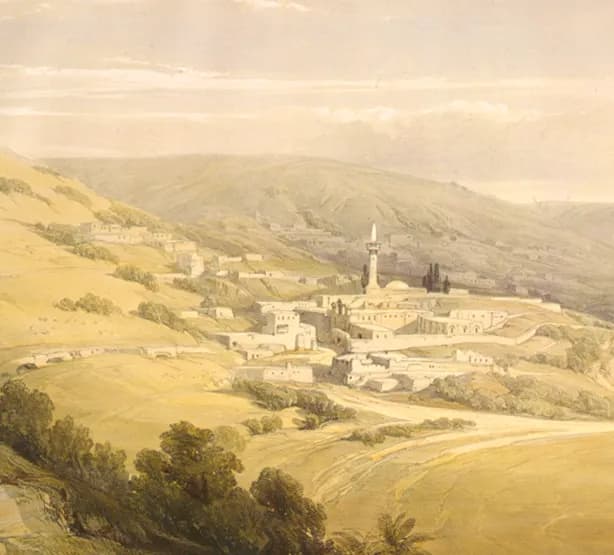
Ephraim's territory occupied the heart of central Palestine—fertile hills intersected by wide plains with running streams, clothed with vegetation and renowned for precious produce. Within its borders lay Shiloh, where the tabernacle rested for centuries, and Shechem, where Jacob had first settled and purchased land. The territory's natural defenses made it secure: fertile plains and well-watered valleys accessible only through steep, narrow ravines nearly impassable for an army. This security, combined with the presence of the central sanctuary, established Ephraim's political and religious leadership among the tribes. Even after the monarchy was established, Ephraim was called 'the strength of mine head.'
☩Ephraim and the Northern Kingdom
From the disruption under Rehoboam, the name Ephraim became virtually synonymous with the northern kingdom of Israel. Jeroboam, who led the revolt, set up his calf worship at Bethel in Ephraimite territory, and Shechem and Samaria—both in Ephraim's land—became the political centers of the north. The prophets therefore consistently use 'Ephraim' and 'Israel' interchangeably when addressing the ten tribes, just as 'Judah' represents the southern kingdom. Isaiah prophesied that within sixty-five years Ephraim would be broken and cease to be a people—fulfilled when Esarhaddon settled foreign colonists in Samaria. Yet prophecies of future restoration speak of Ephraim's return alongside Judah, when the two sticks of Ezekiel's vision become one nation under one king.
Related Verses178 mentions
References
- 1.John McClintock and James Strong, "Ephraim," in Cyclopedia of Biblical, Theological and Ecclesiastical Literature, vol. III (Harper & Brothers, 1867–1887).
- 2.Andrew Robert Fausset, "Ephraim (1)," in The Englishman's Critical and Expository Bible Cyclopædia (Hodder & Stoughton, 1878).
- 3.James Orr (ed.), "Ephraim (1)," in International Standard Bible Encyclopedia, vol. II (Howard-Severance Company, 1915).
- 4.George Morrish, "Ephraim," in Morrish's Concise Bible Dictionary (George Morrish, 1898).