
Wild Ox(unicorn)
“Reem, a large wild bovine; related to Akkadian rimu, 'wild bull'”
Summary
The wild ox (Hebrew reem), often mistranslated 'unicorn' in older versions, was a powerful two-horned beast symbolizing great strength in Scripture.
☩Identity of the Animal
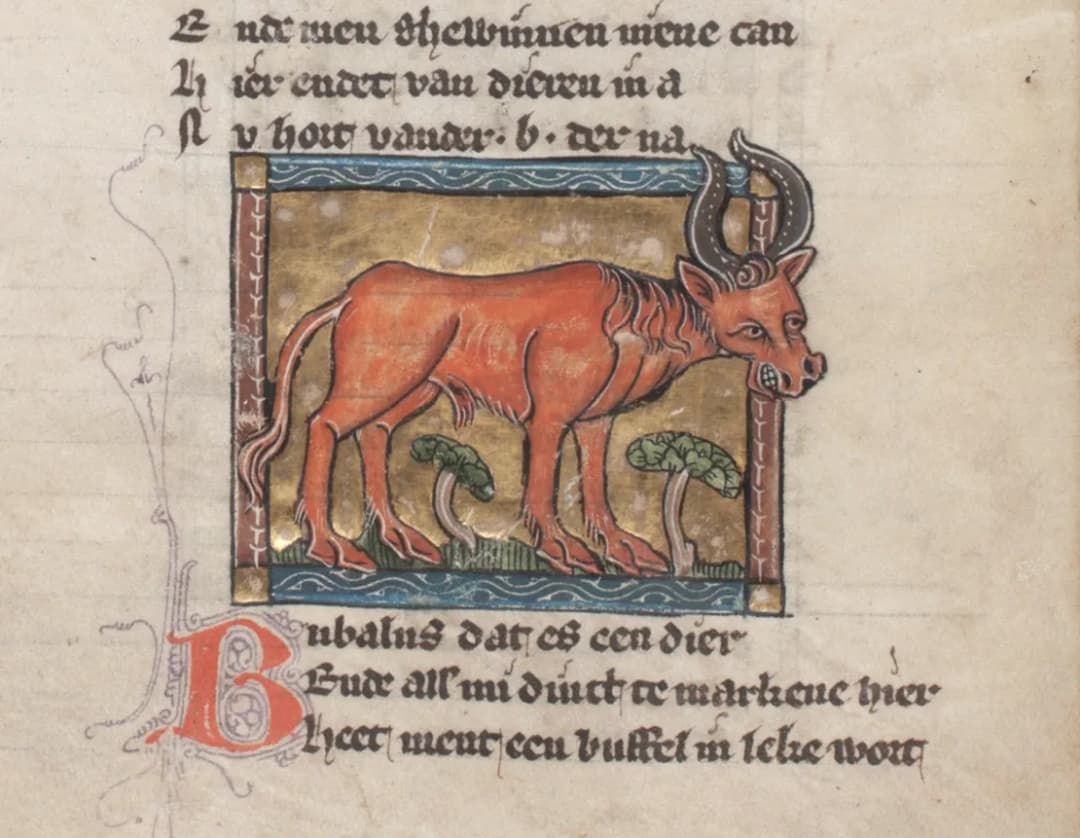
The Hebrew reem was rendered 'unicorn' in the King James Version following the Septuagint's monokeros, but this is certainly incorrect. Deuteronomy 33:17 explicitly mentions 'the horns' (plural) of the reem, ruling out a one-horned animal. The wild ox is characterized by great strength and fierce, untamable disposition—it cannot be put to agricultural use like domestic oxen. Most scholars identify it with the Bos primigenius (aurochs), a gigantic wild ox now extinct, which Caesar described as 'scarcely less than elephants in size.'
☩Biblical References
The reem's great strength is used to symbolize the power God gives to His people: Israel has 'the strength of a wild ox.' The psalmist prays to be saved from the lion's mouth and the horns of the wild oxen, representing fierce enemies. God's exaltation of the righteous is compared to the reem's horn being lifted high. Assyrian sculptures depict the wild ox with the name reem inscribed above it, confirming the identification.
Related Verses11 mentions
References
- 1.John McClintock and James Strong, "Unicorn," in Cyclopedia of Biblical, Theological and Ecclesiastical Literature, vol. X (Harper & Brothers, 1867–1887).
- 2.James Orr (ed.), "Unicorn," in International Standard Bible Encyclopedia, vol. V (Howard-Severance Company, 1915).
- 3.George Morrish, "Unicorn," in Morrish's Concise Bible Dictionary (George Morrish, 1898).
- 4.F. N. Peloubet & M. A. Peloubet (ed.), "Unicorn," in Smith's Bible Dictionary (Porter & Coates, 1884).