
Gibeah
“Hill”
Summary
A city of Benjamin infamous for the atrocity committed there in the period of the Judges, and later known as the birthplace and residence of King Saul.
☩The Atrocity and Its Consequences
The narrative in Judges 19 recounts a tragedy of extraordinary horror. A Levite traveling through Benjamin with his concubine was forced to lodge in Gibeah when darkness fell. When wicked men of the city demanded he be given to them, his concubine was surrendered instead and abused to death throughout the night. The Levite's gruesome method of announcing this crime—cutting her body into twelve pieces and sending them throughout Israel—provoked a war that nearly exterminated the tribe of Benjamin.
☩Gibeah of Saul
Despite its dark history, Gibeah recovered and became the hometown of Saul, Israel's first king. After his anointing at Mizpah, Saul returned home to Gibeah, where a band of men whose hearts God had touched went with him. From here he summoned Israel to relieve Jabesh-gilead, and it remained his royal residence throughout his reign. The city played a significant part in the wars against the Philistines, with Jonathan stationed there with a thousand men.
☩Location and Identification
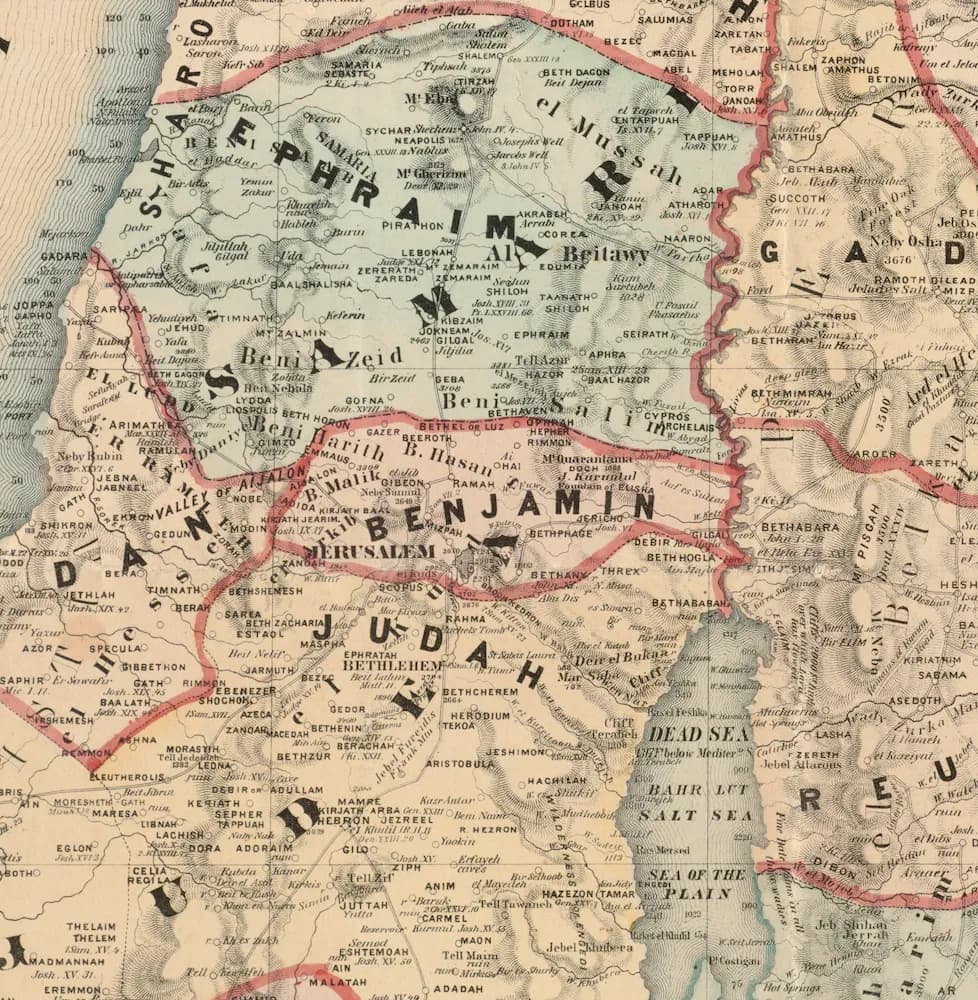
Gibeah of Benjamin is generally identified with Teleil el-Ful, an artificial mound about four miles north of Jerusalem, just east of the main road to Shechem. The site commands extensive views and was well suited as a capital during the troubled times of Saul's reign. Isaiah mentions it in his description of the Assyrian advance on Jerusalem, placing it in sequence with Ramah and other northern towns.
☩Other Places Named Gibeah
Besides the famous Gibeah of Benjamin, Scripture mentions a Gibeah in the mountains of Judah, and a 'Gibeah in the field' mentioned in the account of the Benjamite war. There was also the hill of Phinehas in Mount Ephraim where the high priest Eleazar was buried.
Related Verses49 mentions
See Also
References
- 1.James Orr (ed.), "Gibeah," in International Standard Bible Encyclopedia, vol. II (Howard-Severance Company, 1915).
- 2.John McClintock and James Strong, "Gibeah," in Cyclopedia of Biblical, Theological and Ecclesiastical Literature, vol. III (Harper & Brothers, 1867–1887).
- 3.F. N. Peloubet & M. A. Peloubet (ed.), "Gibeah," in Smith's Bible Dictionary (Porter & Coates, 1884).
- 4.George Morrish, "Gibeah," in Morrish's Concise Bible Dictionary (George Morrish, 1898).