
Balaam
“Devourer of the people, or destroyer of the people”
Summary
A Mesopotamian prophet hired by Balak, king of Moab, to curse Israel, but compelled by God to pronounce blessings instead.
☩Origin and Reputation
Balaam was the son of Beor, a renowned seer from Pethor (Assyrian Pitru), a city in northern Mesopotamia near the Euphrates. This region was famous for soothsayers and magi who congregated in particular locations. He possessed such a fearsome reputation that Balak believed his curses and blessings had real power.
☩Summoned to Curse Israel
When Israel encamped in the plains of Moab after their wilderness wanderings, Balak formed an alliance with Midian and sent elders with rewards to hire Balaam to curse the approaching Israelites. God initially forbade Balaam from going, but after a second embassy with greater gifts, permitted him to go with the condition that he speak only God's words. On the journey, Balaam's donkey saw the Angel of the Lord blocking the path and spoke to rebuke the prophet's blind pursuit of reward.
☩The Blessings
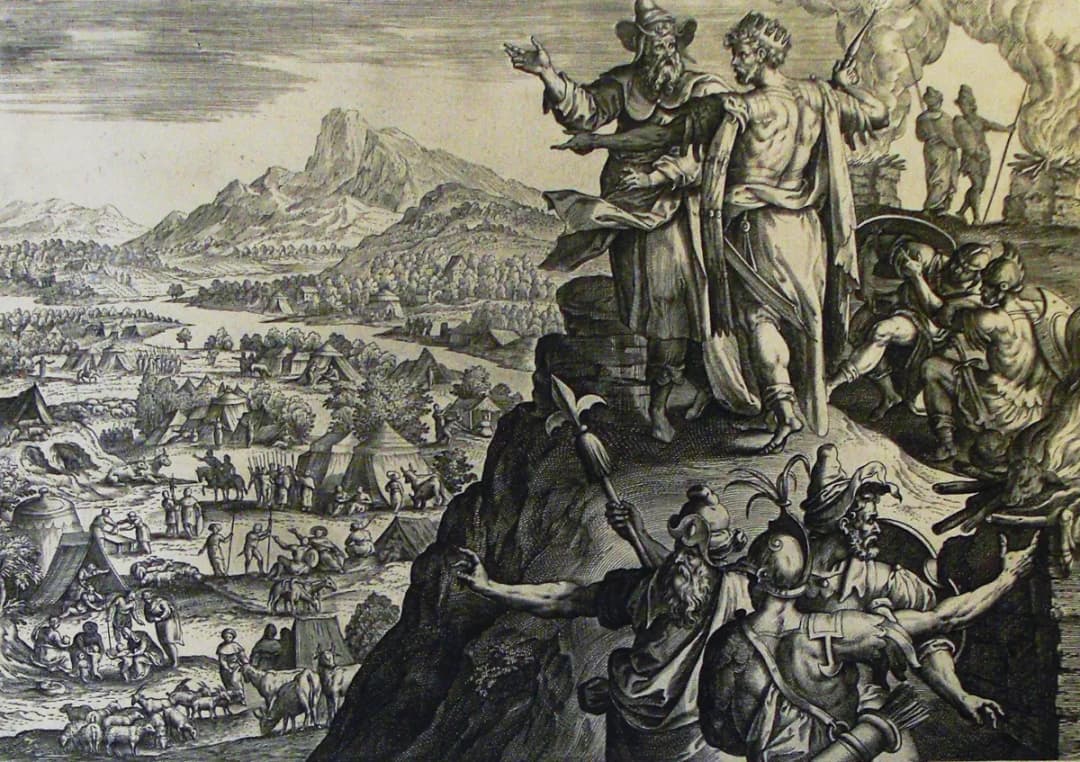
From three successive locations—Bamoth-baal, Pisgah, and Peor—Balaam attempted to curse Israel but was compelled each time to bless them instead. His four oracles declared Israel's uniqueness among nations, their purity of worship, their valor and prosperity, and culminated in the famous messianic prophecy of a star arising from Jacob and a scepter from Israel. These prophecies served to comfort Israel regarding their future among the nations.
☩Treacherous Counsel and Death
Though dismissed by Balak, Balaam did not return home but stayed among the Midianites and devised a scheme to harm Israel through seduction rather than cursing. He counseled Balak to use Midianite and Moabite women to lure Israelite men into sexual immorality and idolatry at Baal-peor, resulting in a plague that killed 24,000. In the subsequent war of vengeance against Midian, Balaam was slain by the sword alongside the five Midianite kings.
☩New Testament Significance
Balaam became the prototype of false teachers who corrupt the church for financial gain. Peter warns against those who follow 'the way of Balaam' who loved the wages of unrighteousness. Jude speaks of those who 'ran greedily after the error of Balaam for reward.' In Revelation, the church at Pergamum is rebuked for tolerating those who hold 'the teaching of Balaam,' which promoted compromise with pagan practices.
Related Verses62 mentions
References
- 1.James Orr (ed.), "Balaam," in International Standard Bible Encyclopedia, vol. I (Howard-Severance Company, 1915).
- 2.George Morrish, "Balaam," in Morrish's Concise Bible Dictionary (George Morrish, 1898).
- 3.James Hastings (ed.), "Balaam," in Dictionary of the Apostolic Church, vol. I (T. & T. Clark, 1915–1918).
- 4.Philip Schaff and Johann Herzog (ed.), "Balaam," in The New Schaff-Herzog Encyclopedia of Religious Knowledge, vol. I (Funk and Wagnalls, 1908–1914).