
Blind
“Sightless, without vision”
Summary
Physical blindness, prevalent in the ancient Near East, served as a frequent metaphor for spiritual darkness, while Jesus' healing of the blind demonstrated His messianic identity.
☩Prevalence in the East
Blindness was extremely common in the ancient Near East due to ophthalmia, intense sun-glare, sand and dust, temperature extremes, and neglect of treatment. Travelers reported that in some Eastern cities, one in five people was blind or partially sighted. Blind beggars were a common sight, as seen frequently in the Gospel narratives.
☩Legal Protection
The Mosaic law showed compassion toward the blind, forbidding putting a stumbling block before them, invoking a curse upon anyone who led them astray, and commanding care for the vulnerable. To cause someone's blindness was punishable, and the priests could not include anyone blind in their number.
☩Messianic Sign
Isaiah prophesied that when the Messiah came, 'the eyes of the blind shall be opened.' When John the Baptist sent disciples to ask if Jesus was the Coming One, Jesus pointed to His miracles, including that 'the blind receive their sight,' as evidence of His messianic identity. The healing of the blind was uniquely associated with Jesus and not attributed to the disciples independently.
☩Jesus' Healings
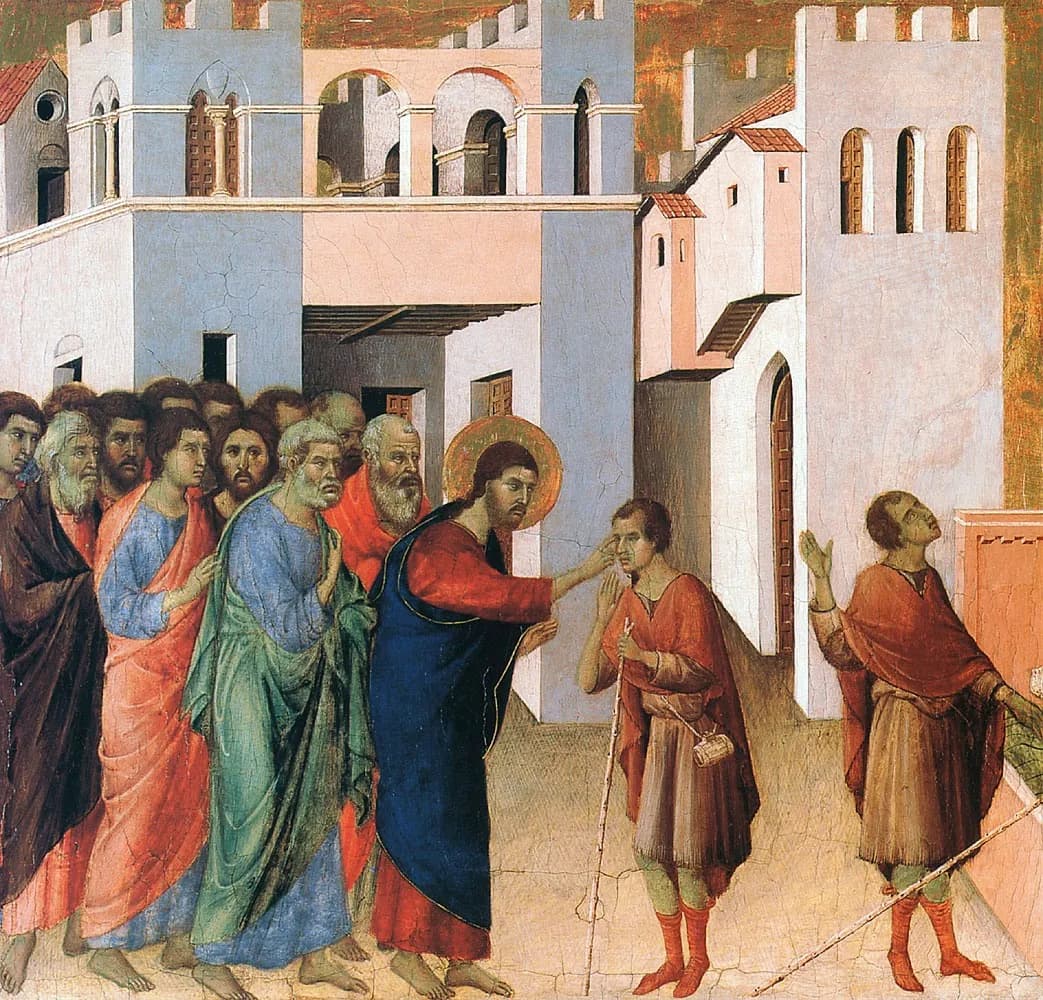
The Gospels record multiple instances of Jesus healing the blind: two blind men at Capernaum, a man at Bethsaida (healed gradually), Bartimaeus at Jericho, and the man born blind in Jerusalem. Each healing demonstrated not only Christ's power but also the importance of faith, as Jesus often asked about or commended the recipient's faith. The healing at Bethsaida, where sight was restored in stages, uniquely illustrates spiritual awakening that sometimes comes gradually.
☩Spiritual Blindness
Physical blindness symbolizes spiritual darkness—the inability to perceive divine truth. The Pharisees, though physically sighted, were spiritually blind, leading Jesus to pronounce them 'blind guides.' When Jesus healed the man born blind, He declared: 'For judgment I am come into this world, that they which see not might see; and that they which see might be made blind.' Paul was struck blind on the Damascus road, symbolizing his spiritual condition before conversion.
Related Verses80 mentions
See Also
References
- 1.John McClintock and James Strong, "Blind," in Cyclopedia of Biblical, Theological and Ecclesiastical Literature, vol. I (Harper & Brothers, 1867–1887).
- 2.James Hastings (ed.), "Blindness," in Dictionary of Christ and the Gospels, vol. I (T. & T. Clark, 1906–1908).
- 3.James Hastings (ed.), "Blindness," in Dictionary of the Apostolic Church, vol. I (T. & T. Clark, 1915–1918).