
Pharisees
Summary
The Pharisees were the most influential religious sect among Jews in the time of Christ, characterized by strict observance of the written and oral law, belief in resurrection and angels, and a separatist spirit that often manifested as self-righteous formalism.
☩Name and Origin
The name 'Pharisees' derives from the Aramaic *perishin* (Hebrew *perushim*), meaning 'separated ones'—those who carefully kept themselves from legal contamination, distinguishing themselves from the common people (*'am ha'arets*) who had fewer scruples. They were successors to the Hasideans (*chasidhim*, 'pious ones'), who voluntarily devoted themselves to the Law during the Maccabean period. When the Hasmonean princes became increasingly involved in worldly politics, the strict Assideans withdrew and formed a theocratic group, gaining leadership of the majority of Jews. The name 'Pharisees' became current when they withdrew from the Sadducee court party under John Hyrcanus (135-105 BC).
☩Doctrines and Beliefs
The fundamental principle of the Pharisees was that alongside the written Law, an oral law was given to Moses on Sinai and transmitted through the prophets to the 'men of the great synagogue.' This oral tradition, later codified in the Mishna, came to be esteemed far above the sacred text itself. The Pharisees believed in the resurrection of the dead, angels and spirits, divine providence working alongside human free will, and an elaborate eschatology including heaven, hell, and the intermediate state (Acts 23:8). They differed from the Sadducees, who were agnostic about these matters and rejected the oral traditions. Their scrupulous tithing was based on Mishna regulations making them 'trustworthy' in religious matters.
☩Influence and Organization
The Pharisees were the religious power in Palestine in Christ's time, representing scriptural authority in home, school, synagogue, and courts. Though numbering only about 6,000-7,000 members in their brotherhood, they influenced the great majority of Jews who shared their beliefs. Members called each other *chabherim* ('neighbors' or 'associates'), taking vows to tithe everything and observe ceremonial purification. They were in business, and their goods were considered ritually acceptable everywhere. Their missionary zeal led them to compass sea and land to make proselytes (Matthew 23:15). Josephus compared them to the Stoics, noting they lived frugally and gained more popular support than the aristocratic Sadducees.
☩Christ's Conflict with the Pharisees
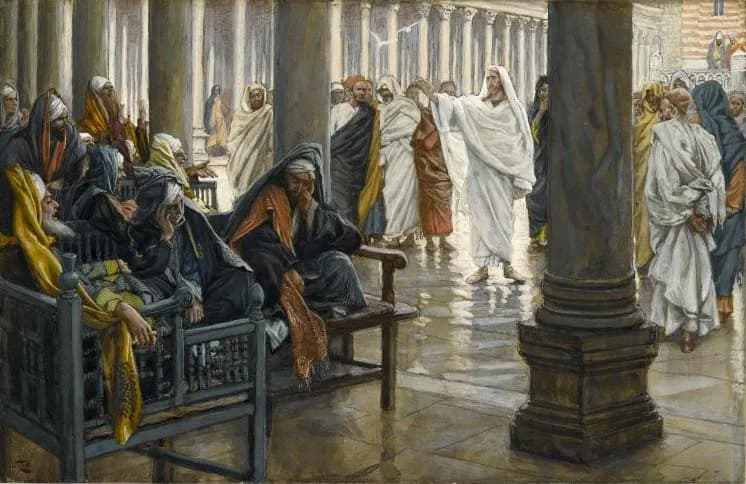
Jesus, the meek and loving One, denounced the Pharisees with unusual severity, exposing their hypocrisy, ostentatious piety, real love of preeminence, and covetousness hidden behind long prayers (Matthew 23:5-33). He charged them with making God's word of none effect through their traditions, straining out gnats while swallowing camels, cleansing the exterior while being full of iniquity within—like 'whited sepulchres' (Matthew 23:23-27). Yet Jesus did not denounce all Pharisees; He had friendly relations with individuals like Nicodemus and Simon the Pharisee, and the noble types such as Gamaliel and Paul showed that the best Jewish character could be found among them. Jesus stood nearer the synagogue than the Temple, and in some respects presented His teaching in line with Pharisaic emphases on Scripture and righteousness.
☩Legacy and Later Development
After Jerusalem's fall in AD 70, the Pharisees emerged as the sole surviving Jewish party, the Sadducees having disappeared with Temple and priesthood. 'Later Judaism is through and through Pharisaism and nothing but Pharisaism.' The breach widened between the Pharisee and the common people; certain rabbis forbade transactions with the *'am ha'arets* and declared hatred of them greater than Gentile hatred of Israel. The missionary propaganda that had characterized earlier Pharisaism ceased after the fall of Jerusalem, and the exclusive tendency reigned supreme. Paul's remembrance of his former bondage as a rigid Pharisee produced that reaction which led to his uncompromising maintenance of Christian liberty and justification by faith alone.
Related Verses92 mentions
References
- 1.James Orr (ed.), "Pharisees," in International Standard Bible Encyclopedia, vol. IV (Howard-Severance Company, 1915).
- 2.James Hastings (ed.), "Pharisees," in Dictionary of the Apostolic Church, vol. II (T. & T. Clark, 1915–1918).
- 3.James Hastings (ed.), "Pharisees," in Dictionary of Christ and the Gospels, vol. II (T. & T. Clark, 1906–1908).
- 4.Philip Schaff and Johann Herzog (ed.), "Pharisees and Saducees," in The New Schaff-Herzog Encyclopedia of Religious Knowledge, vol. IX (Funk and Wagnalls, 1908–1914).
- 5.F. N. Peloubet & M. A. Peloubet (ed.), "Pharisees," in Smith's Bible Dictionary (Porter & Coates, 1884).
- 6.Andrew Robert Fausset, "Pharisees," in The Englishman's Critical and Expository Bible Cyclopædia (Hodder & Stoughton, 1878).