
Ebal
“Stone, or bare mountain”
Summary
A mountain in central Canaan, opposite Mount Gerizim, where the curses of the law were pronounced and where Joshua built an altar after Israel's entry into the promised land.
☩Geography and Location
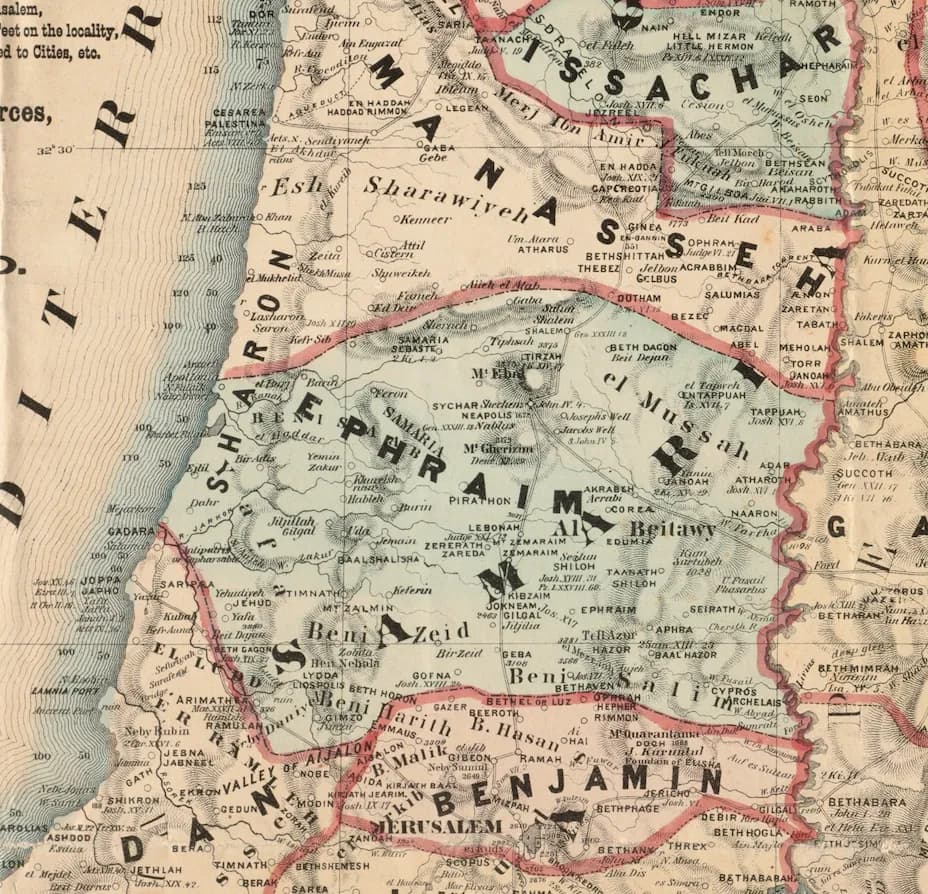
Mount Ebal rises north of the vale of Shechem, opposite Mount Gerizim to the south. The mountain reaches 3,077 feet above sea level—over 200 feet higher than Gerizim, despite Samaritan claims to the contrary. The ancient city of Shechem (modern Nablus) lies in the throat of the valley between these two mountains. The lower slopes are covered with gardens and orchards, watered by springs from Gerizim, but higher elevations are rocky and barren. From its broad summit, one can see the Mediterranean to the west, Mount Carmel and the plain of Esdraelon to the north, Mount Hermon and Gilead to the east, and the heights around Jerusalem to the south. The pass between these mountains provided the main artery of travel between east and west.
☩The Covenant Ceremony
Moses commanded that upon entering Canaan, Israel should conduct a solemn ceremony of covenant renewal between these two mountains. Six tribes—those descended from Jacob's proper wives—were to stand on Gerizim to respond to the blessings, while six tribes—four from the handmaids plus Reuben and Zebulun—stood opposite on Ebal to respond to the curses. The Levites with the ark stood in the valley between, pronouncing the blessings and curses while all Israel responded 'Amen.' The acoustic properties of this natural amphitheater allow voices on one mountain to be clearly heard on the other. Rocky amphitheatrical recesses on both mountainsides may have accommodated the assembled tribes during this ceremony.
☩The Altar on Ebal
Despite the curses being pronounced from Ebal, God commanded that the first great altar in Canaan be built on this mountain. The altar was to be constructed of large unhewn stones, plastered with lime, and inscribed with the words of the law. Peace offerings were sacrificed on it, and a feast of rejoicing accompanied the ceremony. Joshua faithfully executed these commands after the victory at Ai. The central position of these mountains and their associations with the patriarchs made them ideal for this foundational ceremony. Here Abraham first rested in Canaan and built an altar; here Jacob purchased land and erected the altar El-elohe-Israel.
☩Persons Named Ebal
Two individuals in Scripture bear the name Ebal. The first was a son of Shobal, himself a son of Seir the Horite in Edom. The second appears as a son of Joktan in the genealogy of Shem, though in Genesis 10:28 the name is spelled Obal.
Related Verses8 mentions
See Also
References
- 1.James Orr (ed.), "Ebal, Mount," in International Standard Bible Encyclopedia, vol. II (Howard-Severance Company, 1915).
- 2.Andrew Robert Fausset, "Ebal," in The Englishman's Critical and Expository Bible Cyclopædia (Hodder & Stoughton, 1878).
- 3.John McClintock and James Strong, "Ebal," in Cyclopedia of Biblical, Theological and Ecclesiastical Literature, vol. III (Harper & Brothers, 1867–1887).
- 4.F. N. Peloubet & M. A. Peloubet (ed.), "Ebal," in Smith's Bible Dictionary (Porter & Coates, 1884).