
Edom(idumea)
“Red”
Summary
The name given to Esau because of the red pottage for which he sold his birthright, and by extension the name of his descendants (the Edomites) and the mountainous territory they occupied south of the Dead Sea.
☩Origin of the Name
Edom, meaning 'red,' was the surname given to Esau, Isaac's firstborn and Jacob's twin brother, when he sold his birthright for a dish of red lentil pottage. The name proved appropriate not only for this incident but also for the reddish hue of the mountainous territory his descendants would occupy. The land had earlier been called Mount Seir, meaning 'rugged,' a description fitting both the hairy progenitor of the Horites whom Esau's people displaced and the rough, forested terrain itself.
☩The Territory
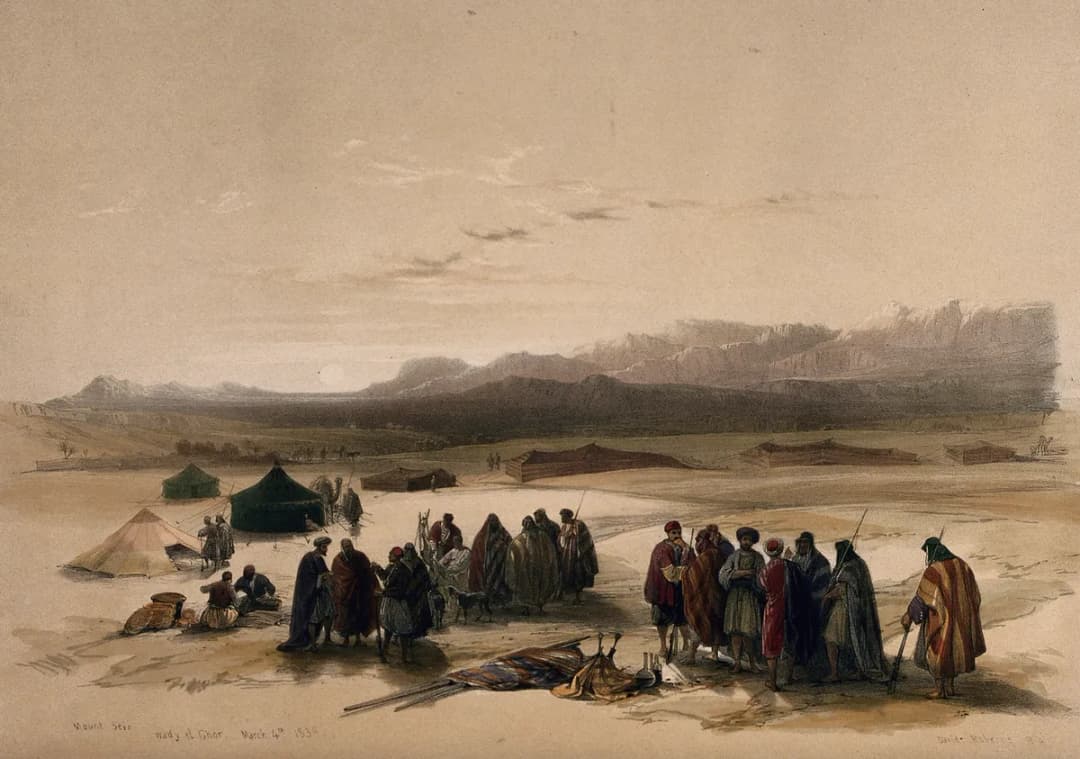
The land of Edom extended from Moab in the north southward to the Gulf of Aqaba, approximately 100 miles in length. On the east it bordered the desert, and on the west it extended into the Arabah. The terrain is remarkably mountainous, with lofty peaks, deep ravines, and some productive plains. Bozrah and Sela (Petra) were its chief cities. The mountains were so precipitous that Amaziah executed 10,000 Edomite captives by throwing them from the cliffs. Esau began driving out the indigenous Horites with 400 armed men and permanently settled in Mount Seir after Isaac's death, yielding Canaan to Jacob according to his father's blessing.
☩Relations with Israel
When Israel approached Canaan, Moses requested permission to pass through Edom, but they refused, forcing Israel to take the longer route around their territory. This initial hostility characterized relations between the two peoples throughout biblical history. The prophets constantly address Edom, judging them for their 'perpetual hatred' against Israel. When Jerusalem fell to Babylon, the Edomites exulted, crying 'Raze it, raze it, even to the foundation!' Many prophecies speak of Edom's coming judgment, including Obadiah's entire oracle devoted to this subject.
Related Verses102 mentions
See Also
References
- 1.John McClintock and James Strong, "Edom," in Cyclopedia of Biblical, Theological and Ecclesiastical Literature, vol. III (Harper & Brothers, 1867–1887).
- 2.Andrew Robert Fausset, "Edom," in The Englishman's Critical and Expository Bible Cyclopædia (Hodder & Stoughton, 1878).
- 3.George Morrish, "Edom," in Morrish's Concise Bible Dictionary (George Morrish, 1898).