
Armies(tactics)
Summary
Organized military forces in Israel, evolving from tribal militia with each tribe as a regiment to a standing army under David and Solomon, with conscription, exemptions, and a religious dimension centered on God as commander.
☩Israelite Military Organization
Every man above twenty was liable for military service . Each tribe formed a regiment with its own banner and leader; positions in camp and on the march were fixed . The army was divided into thousands and hundreds under captains, with the family as the basic unit . David organized the national militia into twelve regiments of 24,000 men each, each called out for one month per year . Before becoming king, David had 600 men and retained the Cherethites and Pelethites; Saul had maintained a bodyguard of 3,000 . Conscription was overseen by genealogists before war; the head of the levy (hashoter) was distinct from the generalissimo (hasofer) . Exemptions from service included those who had built a house not yet inhabited, planted a vineyard or olive grove not yet yielding fruit (five-year exemption), bargained for a spouse but not yet celebrated nuptials or lived with a wife a year, and the faint-hearted . Ranks included men of war (privates), servants (lieutenants), princes (captains), captains (staff officers), and rulers of chariots and horsemen . Genealogists had the right to appoint officers; centurions and chiliarchs were admitted to councils of war .
☩Arms and Equipment
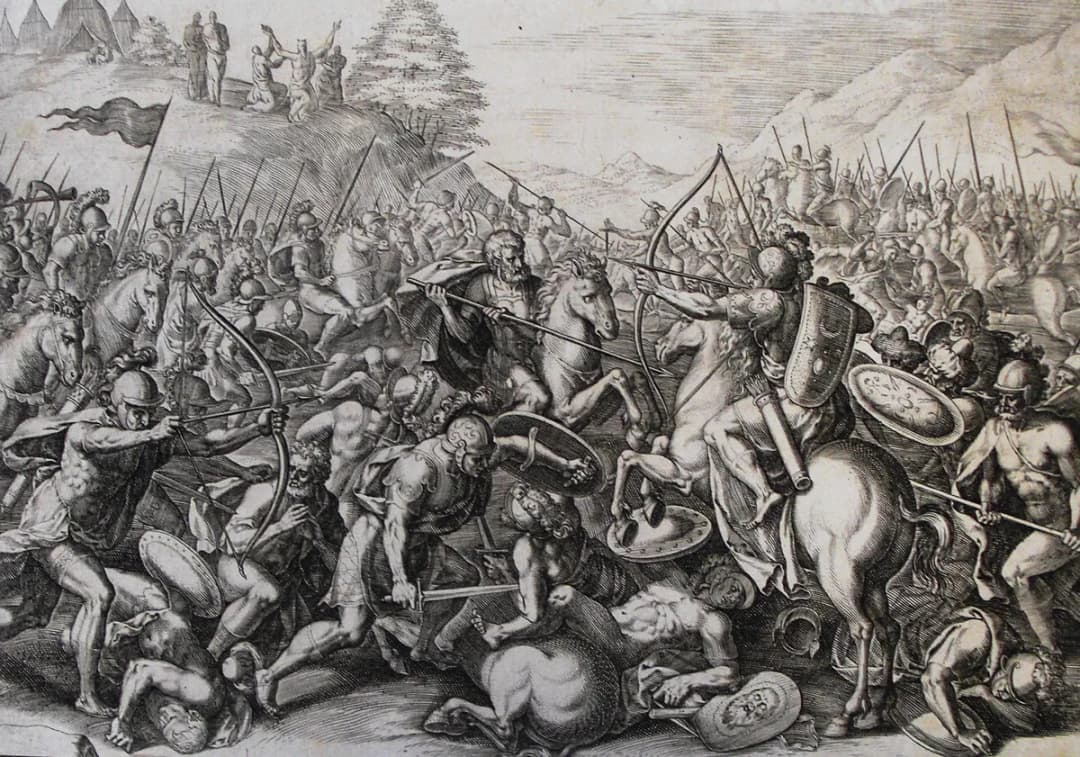
Initially Israel had infantry only; divine command restrained the use of horses . Solomon introduced chariots and cavalry through an Egyptian alliance: 1,400 chariots, 4,000 horses, and 12,000 horsemen . Infantry was divided into light-armed troops (gedudim) and spearmen: the light-armed carried sling, javelin, bow, arrows, quiver, and buckler and fought at a distance; spearmen used spears, swords, and shields for hand-to-hand combat . Light-armed troops were commonly drawn from Ephraim and Benjamin . Armor bearers, chosen from the bravest soldiers, bore arms, relayed commands, and stood by their commanders in peril . In the field, the army often used a three-body division—centre and two wings . The encampment was modeled on Egyptian practice, with the holy tabernacle at the centre and God as prince and leader; Levites encamped nearest as a Praetorian guard, with tribal positions fixed around the tabernacle . Military standards included the degel (four large standards for four divisions), the oth (ensign for family classes), and the nes (a fixed pole with a flag on mountaintops as a signal to assemble) . Soldiers initially armed and fed themselves; a standing army brought maintenance at public expense, and armories existed .
☩Divine Warfare
Scripture presents God as commanding heavenly armies and fighting for Israel . The title 'Lord of hosts' (Yahweh Sabaoth) refers to God as commander of heavenly forces. Victory depended not on military strength but on faithfulness to God: when Israel obeyed, God fought for them; when they disobeyed, they faced defeat. Before battle, priests exhorted the troops, and sacred trumpets were sounded by priests . The encampment itself reflected this theology: the tabernacle stood at the centre, with God as prince and leader of the host .
Related Verses240 mentions
See Also
References
- 1.John McClintock and James Strong, "Army," in Cyclopedia of Biblical, Theological and Ecclesiastical Literature, vol. I (Harper & Brothers, 1867–1887).
- 2.Richard Watson, "Armies," in A Biblical and Theological Dictionary (John Mason, 1831).