
Martha
“Mistress, lady”
Summary
Martha was the sister of Mary and Lazarus of Bethany, known for her practical hospitality and later for her confession of faith in Christ before the raising of her brother.
☩Character and Household
Martha appears to have been the elder sister and head of the household at Bethany, receiving Jesus into 'her house.' Her name, from the Aramaic meaning 'mistress' or 'lady,' reflects her position. She was practical and energetic in temperament, contrasting with her more contemplative sister Mary. Jesus loved Martha and her household, frequently staying with them when visiting Jerusalem.
☩The Rebuke
When Jesus visited their home, Martha was 'cumbered about much serving'—distracted by preparations for the meal. Meanwhile Mary sat at Jesus' feet, listening to His teaching. Martha complained to Jesus that her sister had left her to serve alone, asking Him to bid Mary help her. Jesus gently reproved her: 'Martha, Martha, thou art careful and troubled about many things: but one thing is needful: and Mary hath chosen that good part, which shall not be taken away from her.' The repetition of her name indicates affectionate reproof rather than harsh criticism.
☩Faith at the Raising of Lazarus
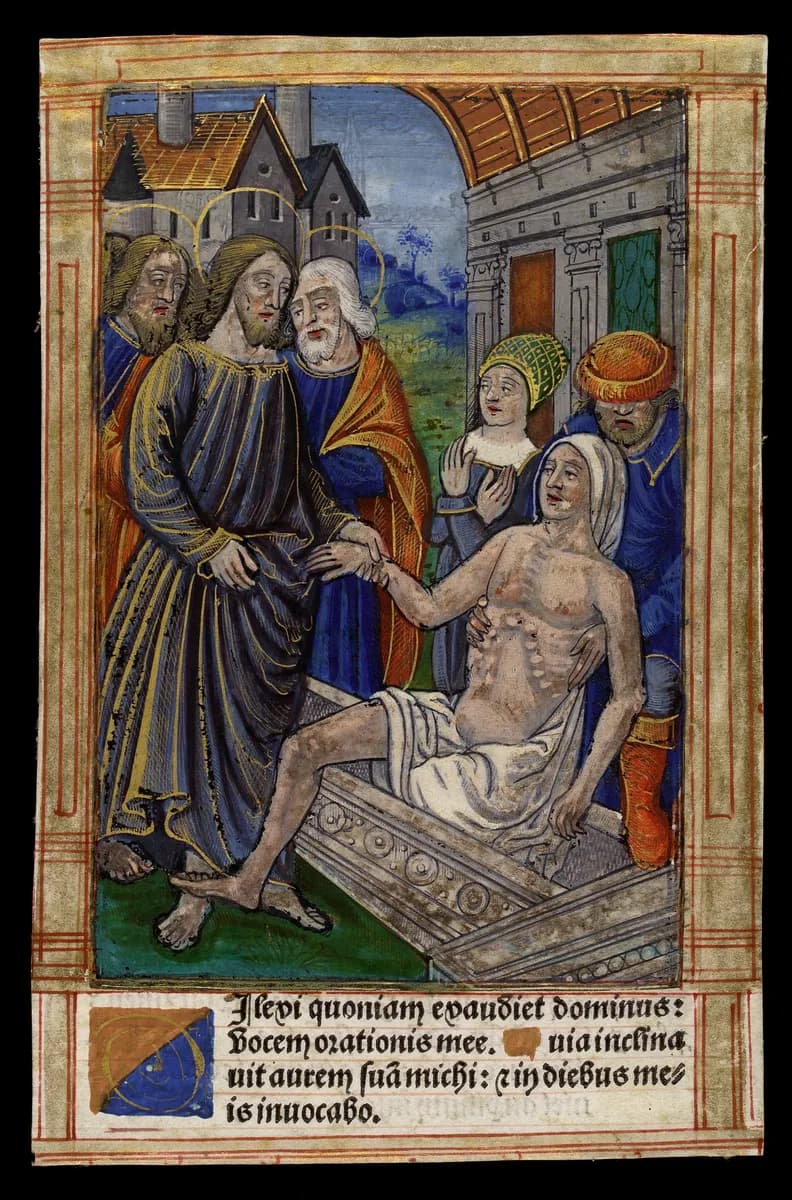
When Lazarus died, Martha went out to meet Jesus as He approached Bethany, while Mary remained in the house mourning. Her greeting combined faith with mild reproach: 'Lord, if thou hadst been here, my brother had not died. But I know, that even now, whatsoever thou wilt ask of God, God will give it thee.' When Jesus declared 'I am the resurrection and the life,' Martha responded with one of Scripture's great confessions: 'Yea, Lord: I believe that thou art the Christ, the Son of God, which should come into the world.' Yet her faith was tested when Jesus ordered the tomb opened, and she objected practically: 'Lord, by this time he stinketh.'
☩Later Appearance
At the supper in Bethany six days before the Passover, Martha again served while Lazarus reclined at table and Mary anointed Jesus' feet. Her service is now mentioned without qualification—she had learned the needed lesson, serving in calm communion with the Lord rather than anxious distraction. Activity and devotion were now combined in proper balance.
References
- 1.F. N. Peloubet & M. A. Peloubet (ed.), "Martha," in Smith's Bible Dictionary (Porter & Coates, 1884).
- 2.James Orr (ed.), "Martha," in International Standard Bible Encyclopedia, vol. III (Howard-Severance Company, 1915).
- 3.John McClintock and James Strong, "Martha," in Cyclopedia of Biblical, Theological and Ecclesiastical Literature, vol. V (Harper & Brothers, 1867–1887).
- 4.Andrew Robert Fausset, "Martha," in The Englishman's Critical and Expository Bible Cyclopædia (Hodder & Stoughton, 1878).