
Bee
“Bee, possibly related to a root meaning to speak or arrange, suggesting the bee's organized behavior”
Summary
A honey-producing insect abundant in Palestine, mentioned in Scripture primarily for its aggressive swarming behavior and as the source of the honey that made the land 'flow with milk and honey.'
☩Bees in Palestine
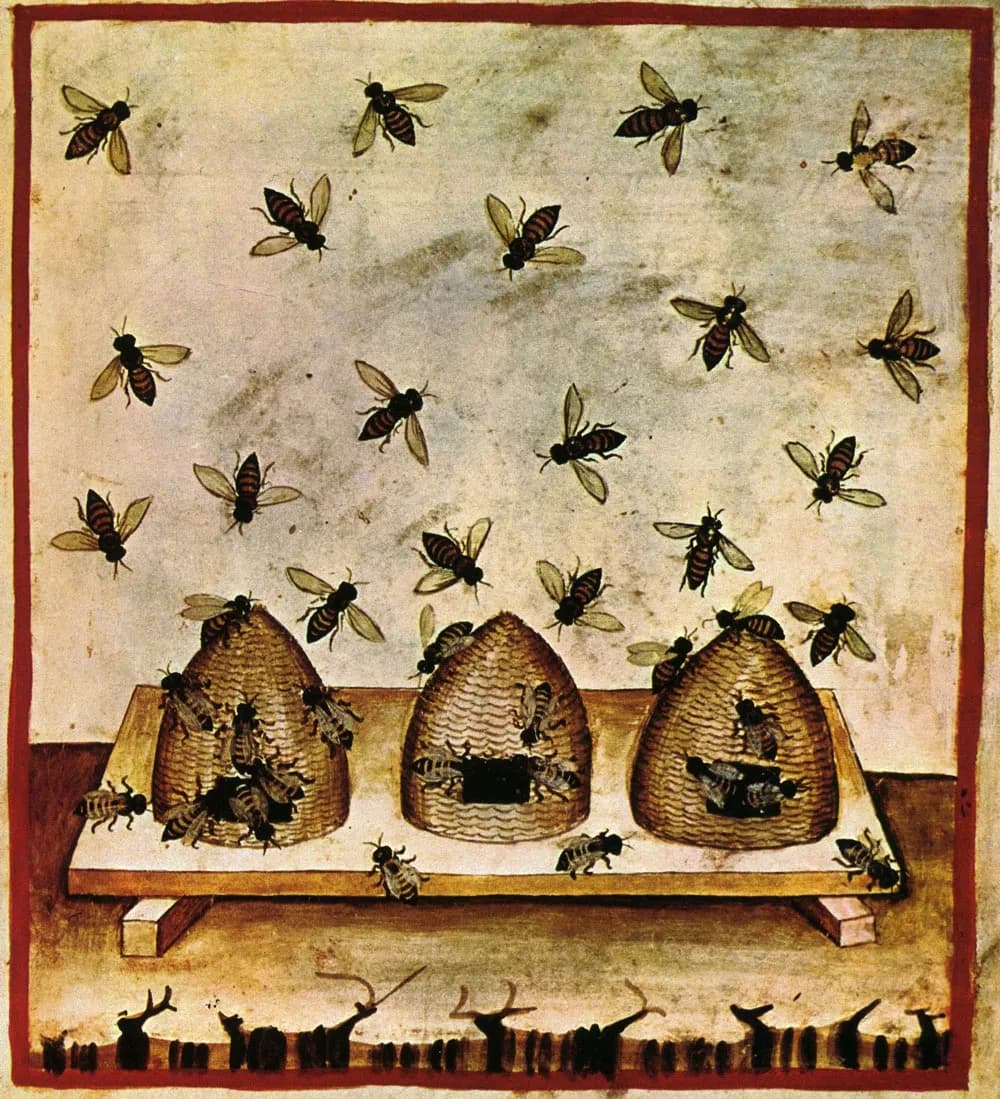
Bees were extremely common in Palestine, both wild and possibly domesticated, providing the abundant honey that characterized the Promised Land as 'flowing with milk and honey.' Wild bees made their nests in clefts of rocks, hollow trees, and even animal carcasses. The personal name Deborah ('bee') given to Rebekah's nurse and the famous judge suggests the insect was associated with industriousness and fruitfulness.
☩Samson's Riddle
Samson discovered a swarm of bees and honey in the dried carcass of the lion he had previously killed, giving rise to his famous riddle: 'Out of the eater came forth meat, and out of the strong came forth sweetness.' The hot, dry climate of Palestine can quickly desiccate a carcass, leaving it free from decay and suitable as a nesting site. The incident occurred 'after a time'—likely sufficient for the flesh to be entirely removed, leaving only the bones where the bees could establish their colony.
☩Symbol of Fierce Pursuit
Scripture uses bees as a symbol of relentless, overwhelming attack. The Amorites 'chased you as bees do' refers to the fierce pursuit and painful assault of swarming bees. The psalmist similarly describes being 'compassed about like bees.' The collective fury of disturbed bees was well known—swarms have been recorded driving people from their homes and even killing livestock, making them an apt image of implacable enemies.
☩God's Summoning of Nations
Isaiah prophesied that the Lord would 'hiss for the bee that is in the land of Assyria' and the fly of Egypt, symbolizing God's sovereign summoning of these powerful nations against unfaithful Israel. The imagery is not of calling bees from hives (a practice without historical basis), but of using a whistling signal to attract attention—a common Eastern custom. Just as bees settle in every available space, so the invading forces would occupy every corner of the land.
Related Verses4 mentions
References
- 1.John McClintock and James Strong, "Bee," in Cyclopedia of Biblical, Theological and Ecclesiastical Literature, vol. I (Harper & Brothers, 1867–1887).
- 2.James Orr (ed.), "Bee," in International Standard Bible Encyclopedia, vol. I (Howard-Severance Company, 1915).
- 3.Andrew Robert Fausset, "Bee," in The Englishman's Critical and Expository Bible Cyclopædia (Hodder & Stoughton, 1878).