
Abiathar
“Father of abundance, or the excellent one is father”
Summary
A high priest who escaped the massacre of the priests at Nob, became David's faithful priest throughout his reign, but was later deposed by Solomon for supporting Adonijah's claim to the throne.
☩Escape and Alliance with David
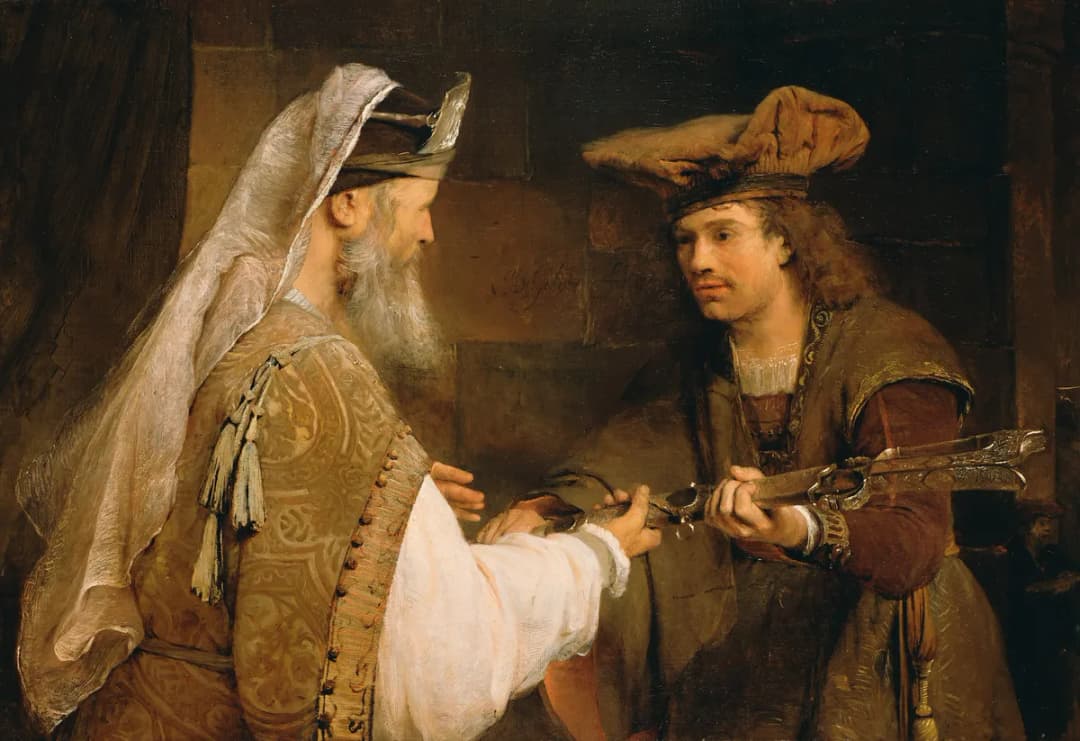
Abiathar was the son of Ahimelech, the high priest at Nob who was slain along with eighty-five priests by Saul for suspected conspiracy with David. Abiathar alone escaped the massacre, fleeing to David with the ephod in his hand, the essential priestly vestment used for divine consultation. David received him warmly, feeling personally responsible for the death of his relatives, and Abiathar became the priest of David's band during all their wanderings. Through the ephod, Abiathar was able to receive divine guidance for David on numerous occasions.
☩High Priest Under David
When David became king, he appointed Abiathar high priest, though Zadok, who had been appointed by Saul, also continued in office. The two served as joint high priests throughout David's reign, with Abiathar bearing the ark before David when it was brought to Jerusalem. During Absalom's rebellion, Abiathar remained loyal to David and helped gather intelligence through his son Jonathan. However, Zadok consistently received precedence, being mentioned first in the accounts and given the more responsible tasks.
☩Deposition by Solomon
When David was old, Abiathar supported Adonijah's attempt to seize the throne instead of Solomon, while Zadok sided with Solomon. After Solomon's accession, Abiathar was deposed from the high priesthood for this disloyalty, though his life was spared because of his priestly status and former services to David. He was banished to his estate at Anathoth, one of the cities assigned to the priests. Solomon's action fulfilled the ancient prophecy through Samuel that the priesthood would be removed from the house of Eli, of whom Abiathar was a descendant.
☩The Question of Mark 2:26
Jesus referred to Abiathar as high priest in connection with David eating the showbread, though the account in 1 Samuel 21 names Ahimelech as the acting priest. This apparent discrepancy has several possible explanations: Abiathar may be mentioned because he later became the more prominent figure, the phrase may mean "in the days of Abiathar who was afterward high priest," or both father and son may have borne both names according to common practice. Abiathar was likely present with his father and may have participated in the priestly duties at that time.
Related Verses31 mentions
See Also
References
- 1.John McClintock and James Strong, "Abiathar," in Cyclopedia of Biblical, Theological and Ecclesiastical Literature, vol. I (Harper & Brothers, 1867–1887).
- 2.James Orr (ed.), "Abiathar," in International Standard Bible Encyclopedia, vol. I (Howard-Severance Company, 1915).
- 3.George Morrish, "Abiathar," in Morrish's Concise Bible Dictionary (George Morrish, 1898).
- 4.James Hastings (ed.), "Abiathar," in Dictionary of Christ and the Gospels, vol. I (T. & T. Clark, 1906–1908).