
Poetry(acrostic poetry)
Summary
Hebrew poetry is a distinctive literary form found throughout Scripture, characterized by parallelism of thought rather than rhyme or meter, expressing the deepest spiritual experiences of God's people.
☩Characteristics of Hebrew Poetry
Hebrew poetry is distinguished from Western poetry in several important ways. It lacks meter in the strict sense and generally lacks rhyme, though isolated cases occur. The defining feature is parallelism—a thought-rhythm where the second line echoes, contrasts with, or builds upon the first. This makes Hebrew poetry uniquely suited for translation, since its essence lies in corresponding thoughts rather than sounds. The vocabulary also differs from prose, using distinctive poetic words and archaic grammatical forms.
☩Types of Parallelism
Three main types of parallelism characterize Hebrew poetry. Synonymous parallelism repeats the first thought with different words, as in 'The heavens declare the glory of God; and the firmament showeth his handiwork.' Antithetic parallelism presents the converse idea: 'The memory of the just is blessed: but the name of the wicked shall rot.' Synthetic or constructive parallelism extends the thought with accessory ideas. Acrostic poems arrange stanzas alphabetically, with Psalm 119's twenty-two sections being the most elaborate example.
☩Development and Purpose
The earliest Hebrew poetry appears in Lamech's speech (Genesis 4:23-24) and shows clear parallelism. Moses' song at the Red Sea, Deborah's victory song, and Hannah's prayer laid the foundation for the full flowering of psalmody under David. David combined creative poetical genius with a special gift of the Spirit, producing psalms that form the chief part of the psalter. Scripture poetry supplied devotional forms to express the spiritual experiences of individual and corporate life.
☩Sacred Music
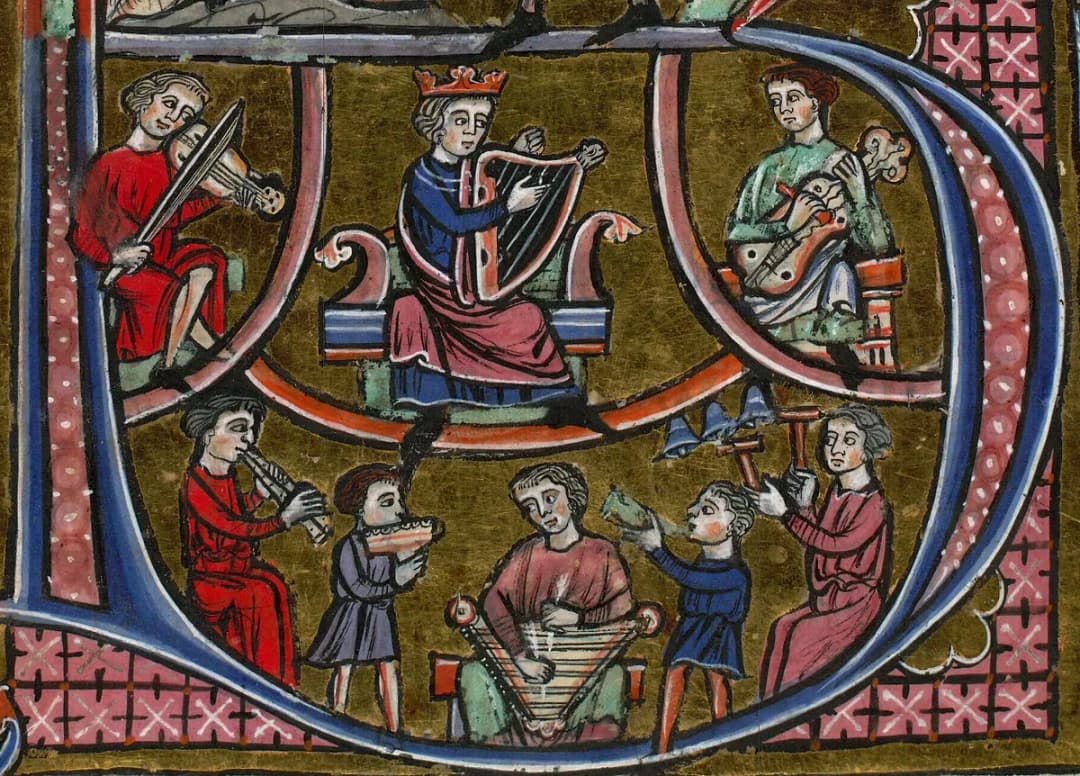
When David became king, he gave psalmody a leading place in public worship, organizing a sacred choir with himself at its head. The three chief musicians—Asaph, Heman, and Jeduthun—led divisions of 288 principal singers, with 4,000 Levite singers in all. Stringed instruments predominated in sacred music, with cymbals reserved for occasions of special joy. David invented or improved some instruments, and the music was entrusted to spiritually gifted men.
Related Verses19 mentions
References
- 1.George Morrish, "Poetry," in Morrish's Concise Bible Dictionary (George Morrish, 1898).
- 2.James Orr (ed.), "Poetry, Hebrew," in International Standard Bible Encyclopedia, vol. IV (Howard-Severance Company, 1915).
- 3.Andrew Robert Fausset, "Poetry," in The Englishman's Critical and Expository Bible Cyclopædia (Hodder & Stoughton, 1878).
- 4.James Orr (ed.), "Poetry, Hebrew," in International Standard Bible Encyclopedia, vol. IV (Howard-Severance Company, 1915).
- 5.Philip Schaff and Johann Herzog (ed.), "Poetry, Hebrew," in The New Schaff-Herzog Encyclopedia of Religious Knowledge, vol. IX (Funk and Wagnalls, 1908–1914).