
Music(al taschith, choruses, gittith, higgaion, maschil, michtam, muth labben, neginoth, nehiloth, sheminith, shushan eduth, singers, singing)
“Song or singing”
Summary
Music held a place of supreme importance in ancient Israel, being cultivated from the earliest times and reaching its golden age under David and Solomon, when it became an essential element of divine worship in the Temple.
☩Origins and Early History
The Hebrew nation made no claim to inventing music but assigned it to the antediluvian age of Jubal, 'the father of all such as handle the harp and organ.' The first mention of music after the Flood appears in Laban's words to Jacob, showing that stringed and wind instruments already accompanied song among the Syrian ancestors of Israel. On the banks of the Red Sea, Moses and the children of Israel sang their triumphal song of deliverance, while Miriam led the women in response with timbrels and dancing. The song of Deborah demonstrates that music accompanied military victories and national celebrations from earliest times.
☩The Golden Age Under David and Solomon
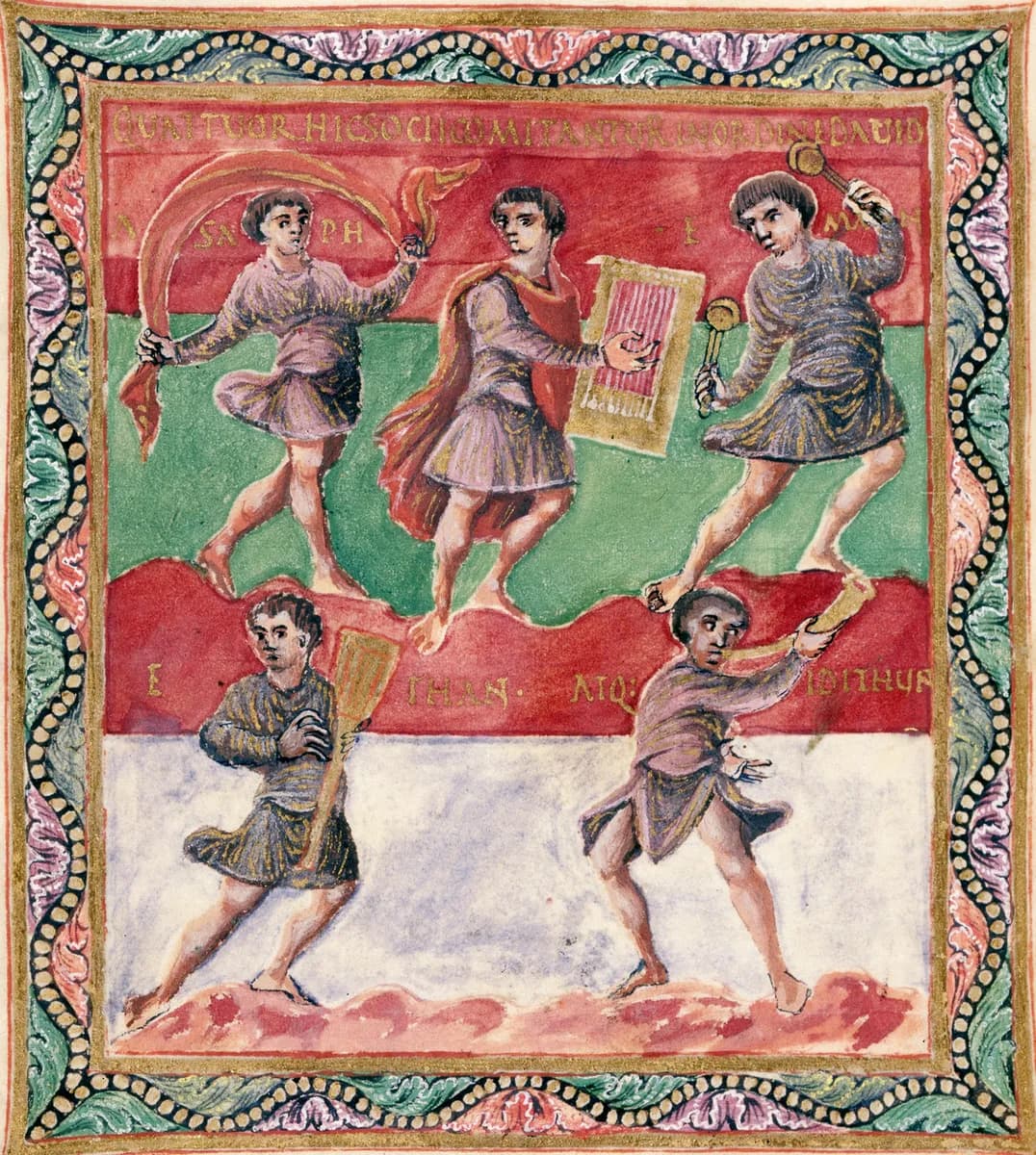
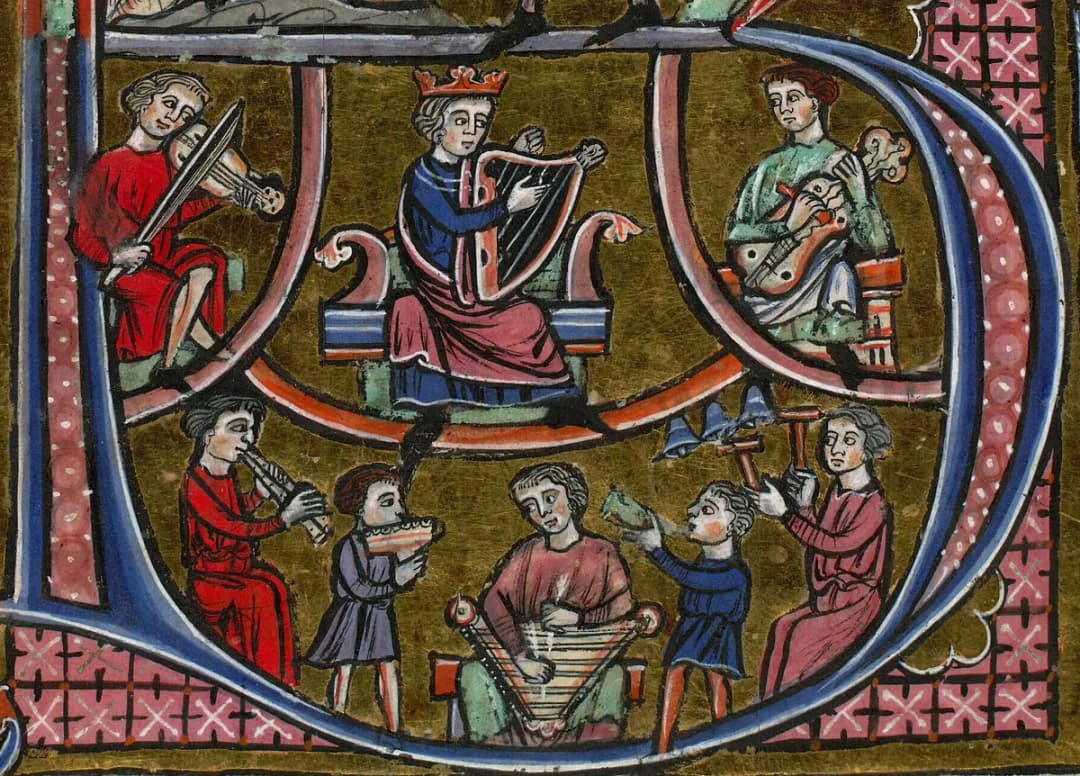
The period of Samuel, David, and Solomon marked a new era in Hebrew music. David gathered 'singing men and singing women' to his court, and Solomon followed likewise, gaining reputation as no mean composer himself with his thousand and five songs. The Temple became the great school of music consecrated to the worship of Jehovah. David chose 4,000 musicians from the Levites—one in ten of the whole tribe—of whom 288 were specially trained. These were divided into 24 courses, each consisting of a full band of 154 musicians under one of the sons of Asaph, Heman, or Jeduthun as conductor. Women also participated in the Temple choir, and the great choirs answered one another in responsive singing.
☩Character and Use
Hebrew music was melody rather than harmony, rendered in unison or octaves, without the counterpoint of modern composition. Its effect depended on contrasts in tone quality, the number of singers, antiphonal arrangements, and instrumental coloring. The term 'Selah,' occurring 71 times in the Psalms, probably indicates an instrumental interlude. Music served religious, therapeutic, and social purposes: it was employed in divine worship, to soothe troubled spirits as when David played for Saul, and to celebrate weddings, triumphs, and banquets. The prophetic schools cultivated music as preparation for receiving spiritual influences.
☩Musical Terms in the Psalms
The Psalm titles preserve numerous musical terms whose precise meanings remain uncertain. 'Neginoth' refers to stringed instruments; 'Nehiloth' to wind instruments or flutes. 'Alamoth' may indicate soprano or treble voice, while 'Sheminith' (the eighth) possibly denotes bass or tenor. 'Maschil' appears to mean instruction or a didactic psalm; 'Michtam' is of uncertain meaning but may indicate a golden or precious psalm. 'Gittith' probably refers to an instrument from Gath, and 'Higgaion' signifies the murmuring tone of a harp played in plaintive manner.
Related Verses242 mentions
References
- 1.John McClintock and James Strong, "Music," in Cyclopedia of Biblical, Theological and Ecclesiastical Literature, vol. VI (Harper & Brothers, 1867–1887).
- 2.James Orr (ed.), "Music," in International Standard Bible Encyclopedia, vol. III (Howard-Severance Company, 1915).
- 3.F. N. Peloubet & M. A. Peloubet (ed.), "Music," in Smith's Bible Dictionary (Porter & Coates, 1884).
- 4.Andrew Robert Fausset, "Music," in The Englishman's Critical and Expository Bible Cyclopædia (Hodder & Stoughton, 1878).