
Pastor
“Shepherd, one who feeds or tends sheep”
Summary
Pastor (Hebrew ro'eh, Greek poimen, both meaning 'shepherd') denotes one who feeds and tends God's flock, used figuratively for spiritual leaders who guide, instruct, and care for believers—distinguished in Ephesians 4:11 as those attached to particular congregations rather than itinerant ministers.
☩Old Testament Usage
In the Old Testament, the word pastor translates the Hebrew ro'eh, from ra'ah meaning 'to feed' or 'to shepherd.' The term appears exclusively in Jeremiah among prophetic books, where it refers to those who should have succored God's people but failed in their duty. Jeremiah pronounces judgment against pastors who destroy and scatter the sheep, contrasting them with faithful shepherds God promises to give His people. The metaphor draws on the common ancient Near Eastern image of rulers as shepherds responsible for the welfare of those under their care, applying it specifically to spiritual leadership.
☩New Testament Significance
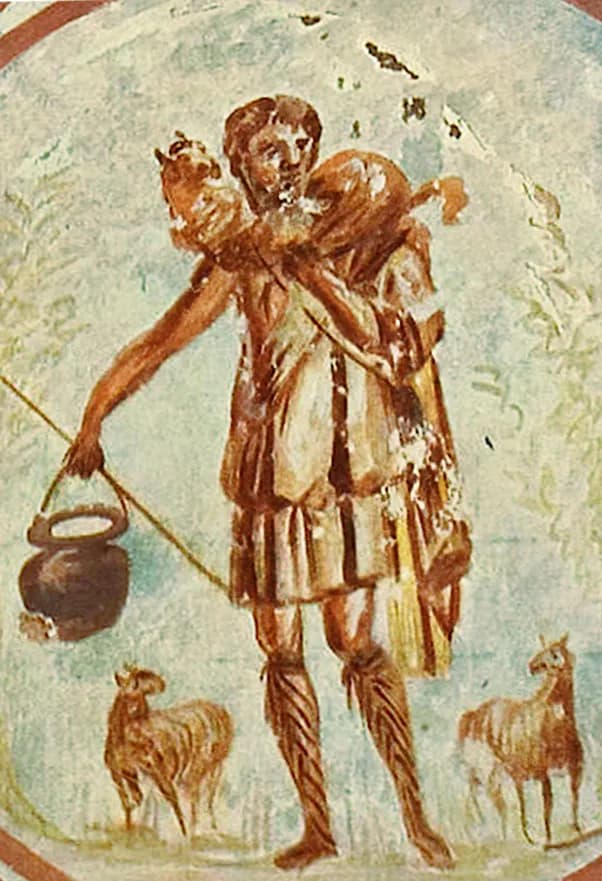
The Greek word poimen appears throughout the New Testament but is translated 'pastor' only in Ephesians 4:11, where it designates a specific ministry gift. Elsewhere poimen is rendered 'shepherd,' applied supremely to Christ as the good shepherd, the great shepherd of the sheep, the Shepherd and Bishop of souls, and the chief Shepherd. The cognate verb poimaino (to tend or shepherd) describes the work of caring for Christian flocks in Christ's charge to Peter, Peter's charge to elders, and Paul's address to the Ephesian elders at Miletus. This pastoral work involves feeding, guiding, protecting, and overseeing believers.
☩Pastors and Teachers
In Ephesians 4:11, while apostles, prophets, and evangelists each have separate articles in Greek, 'pastors and teachers' are coupled by a common article, probably forming only one group. This grammatical construction suggests these functions are closely related though not identical—almost all pastors would be teachers, but not all teachers were pastors. The distinction lies in the pastoral office combining teaching with the ongoing care and oversight of a specific congregation, whereas a teacher might serve more broadly without the shepherding responsibilities attached to local ministry.
☩Nature of Pastoral Ministry
The pastor is one gifted to help saints individually, entering into their trials and difficulties and bringing the word to instruct and comfort them, or to remonstrate with and counsel them when needed. Unlike apostles, prophets, and evangelists who were itinerant preachers and missionaries, pastors and teachers were attached to particular congregations. This local character of pastoral ministry emphasizes the ongoing relationship of care, the personal knowledge of the flock, and the sustained responsibility for spiritual nurture that distinguishes the pastor from other ministry gifts in the church.
See Also
References
- 1.John McClintock and James Strong, "Pastor," in Cyclopedia of Biblical, Theological and Ecclesiastical Literature, vol. VII (Harper & Brothers, 1867–1887).
- 2.George Morrish, "Pastor," in Morrish's Concise Bible Dictionary (George Morrish, 1898).
- 3.James Hastings (ed.), "Pastor," in Dictionary of the Apostolic Church, vol. II (T. & T. Clark, 1915–1918).
- 4.James Orr (ed.), "Pastor," in International Standard Bible Encyclopedia, vol. IV (Howard-Severance Company, 1915).