
Familiar Spirits(familiar)
“Leathern bottle, hence the vessel containing the demon”
Summary
Spirits or demons believed to serve and attend a person, particularly associated with necromancy and divination practices strictly forbidden by Mosaic law.
☩Etymology and Meaning
The Hebrew word 'ob refers to a leathern bottle or water-skin, hence applied to the conjurer regarded as a vessel containing the inspiring demon. The term describes a necromancer or sorcerer who professes to call up the dead by means of incantations to answer questions. The Septuagint renders it engastrimythos, meaning 'ventriloquist,' referring to those who 'peeped and muttered' from the earth to imitate the voice of the revealing spirit. The spirit was called 'familiar' because it was regarded as a servant (famulus) belonging to the family (familiaris), who might be summoned to do the commands of the possessor.
☩Prohibition in Mosaic Law
The practice of consulting familiar spirits was strictly forbidden by the Mosaic law. Those who consulted such spirits were to be cut off from among their people, and those who practiced the craft were subject to the death penalty. The prohibition grouped familiar spirits with other forms of divination, sorcery, and wizardry. The Hebrew 'ob was precisely the same as the Greek pytho, used to designate both the practitioner and the possessing spirit itself.
☩Biblical Examples
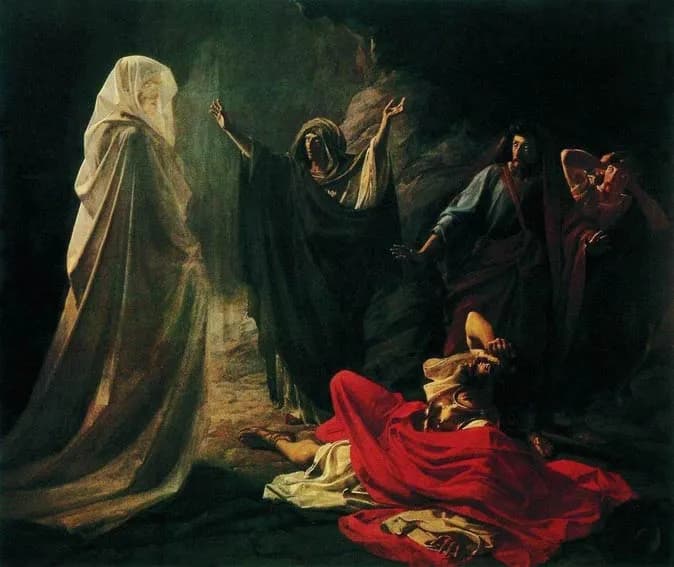
King Saul put away those with familiar spirits early in his reign but hypocritically consulted the witch of Endor who 'had a familiar spirit' when facing the Philistine threat. This act marked the culmination of his spiritual decline and was cited as a cause of his death. King Manasseh fell into the same sin during his wicked reign. The reformer King Josiah put those who dealt with familiar spirits out of the land as part of his religious reforms. Isaiah warned that consulting familiar spirits was vain and futile.
☩Related Practices
Closely connected with familiar spirits was the practice of necromancy, literally 'seeking the dead,' where practitioners frequented tombs or inspected corpses to evoke the dead and bring secrets from the invisible world. Also related was the cheber or spell, an enchantment using cabalistic arrangement of words, sometimes applied to serpent-charming. The yodea or 'knowing one' (wizard) practiced divination through the black art with implied collusion with evil spirits.
Related Verses20 mentions
See Also
References
- 1.John McClintock and James Strong, "Familiar Spirit," in Cyclopedia of Biblical, Theological and Ecclesiastical Literature, vol. III (Harper & Brothers, 1867–1887).
- 2.James Orr (ed.), "Familiar," in International Standard Bible Encyclopedia, vol. II (Howard-Severance Company, 1915).