
Bashan
“Fertile or fruitful soil, possibly from a root meaning smooth or soft land”
Summary
A fertile region east of the Jordan River, famous for its oaks, pastures, and cattle, conquered from the giant king Og and allotted to the half-tribe of Manasseh.
☩Location and Boundaries
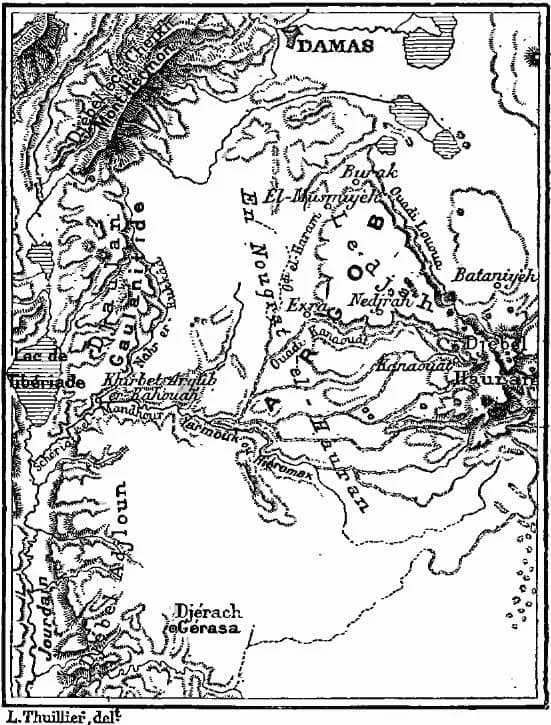
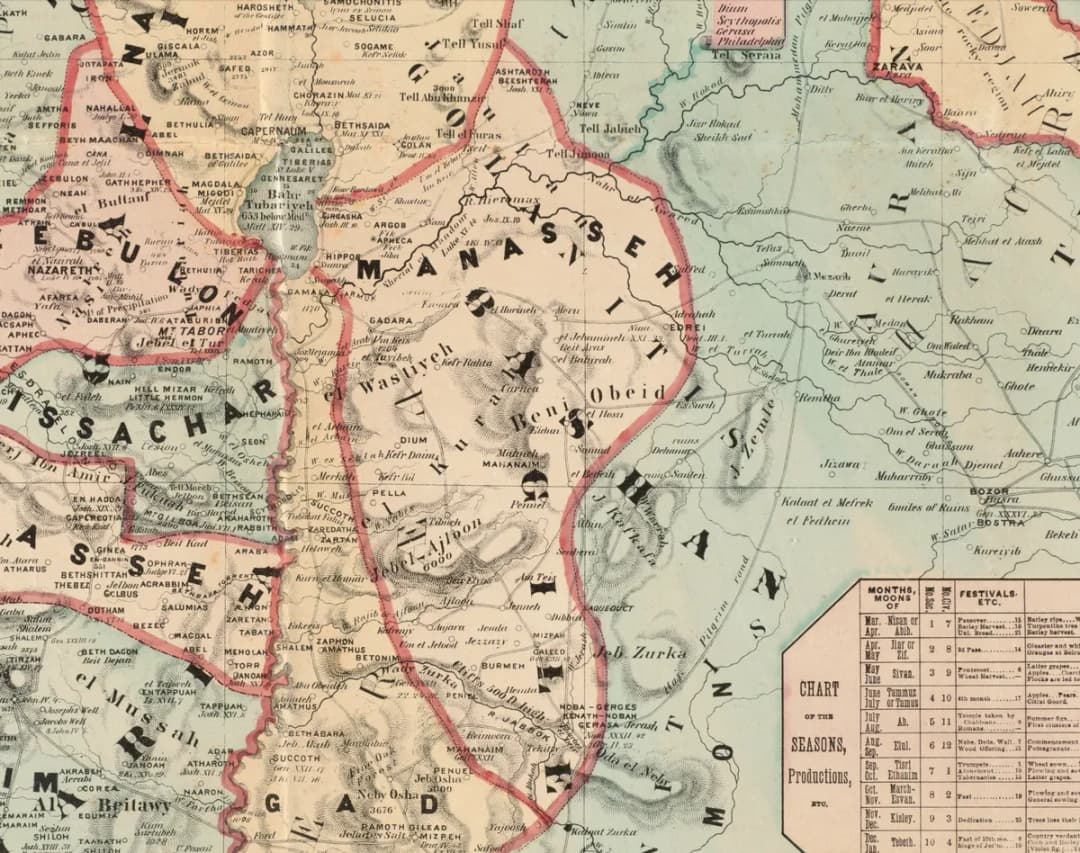
Bashan was the northernmost part of the land east of the Jordan, extending from the border of Gilead on the south to Mount Hermon on the north, and from the Jordan valley and Sea of Galilee on the west to Salcah and the desert on the east. The name probably derives from an Arabic root meaning 'fertile plain' or 'wheatland,' aptly describing its rich volcanic soil. After the exile, the region was divided into four provinces: Gaulanitis (the Golan), Auranitis (the Hauran), Trachonitis (the Lejah), and Batanaea.
☩Conquest from Og
When Israel completed their conquest of Sihon's territory, they turned northward and encountered Og, king of Bashan, at Edrei. Og was 'of the remnant of the giants' (Rephaim), and his iron bedstead was preserved in Rabbah of Ammon, measuring nine cubits long by four wide—a testament to his enormous size. Despite his fearsome reputation, Israel utterly destroyed Og with all his people and took possession of his land, including sixty fortified cities with high walls and gates in the region of Argob alone.
☩Allotment to Manasseh
Moses allotted Bashan to the half-tribe of Manasseh, together with half of Gilead, because they were a numerous tribe with many cattle requiring extensive pasture lands. Jair of Manasseh took the region of Argob as far as the border of the Geshurites and Maacathites, naming it Havvoth-jair after himself. The Levitical cities of Golan (a city of refuge) and Beeshterah (Ashtaroth) were assigned to the Gershonite Levites within this territory.
☩Fertility and Products
Bashan's extraordinary fertility was proverbial in Scripture. The 'strong bulls of Bashan' represented overwhelming, merciless enemies in the Psalms, reflecting the region's renowned cattle. The oaks of Bashan rivaled the cedars of Lebanon in fame; Ezekiel records that Tyre made its oars from them. The prophets used Bashan's fertility alongside Carmel as symbols of the land's fruitfulness, and their languishing as a sign of divine judgment.
☩Later History
Toward the end of Jehu's reign, Hazael king of Syria invaded and smote the entire territory east of Jordan, including Gilead and Bashan. Jehoash later recovered these cities from Hazael's son Ben-hadad. The region was eventually incorporated into the Assyrian empire by Tiglath-pileser III, who carried away the Transjordanian tribes into captivity. In New Testament times, it formed part of the tetrarchy of Philip and later Agrippa II.
Related Verses57 mentions

References
- 1.John McClintock and James Strong, "Bashan," in Cyclopedia of Biblical, Theological and Ecclesiastical Literature, vol. I (Harper & Brothers, 1867–1887).
- 2.James Orr (ed.), "Bashan," in International Standard Bible Encyclopedia, vol. I (Howard-Severance Company, 1915).
- 3.Philip Schaff and Johann Herzog (ed.), "Bashan," in The New Schaff-Herzog Encyclopedia of Religious Knowledge, vol. I (Funk and Wagnalls, 1908–1914).