
Ain
“Eye, or fountain (spring of living water)”
Summary
A Hebrew word meaning "eye" or "fountain," used as the name of a city in Simeon and a landmark on the northern boundary of Palestine.
☩The Word Ain
The Hebrew word ain (ayin) literally means "eye" but is commonly used to designate a spring or natural fountain of living water. This is distinguished from beer or bor, which refers to a dug well or cistern. Springs abound in Palestine, forming remarkable features of the landscape, and the word often appears as a prefix in place names, represented by "En-" (such as En-gedi, En-dor). The accurate use of this word in Scripture reflects the distinction between natural springs and artificial wells.
☩City of Simeon
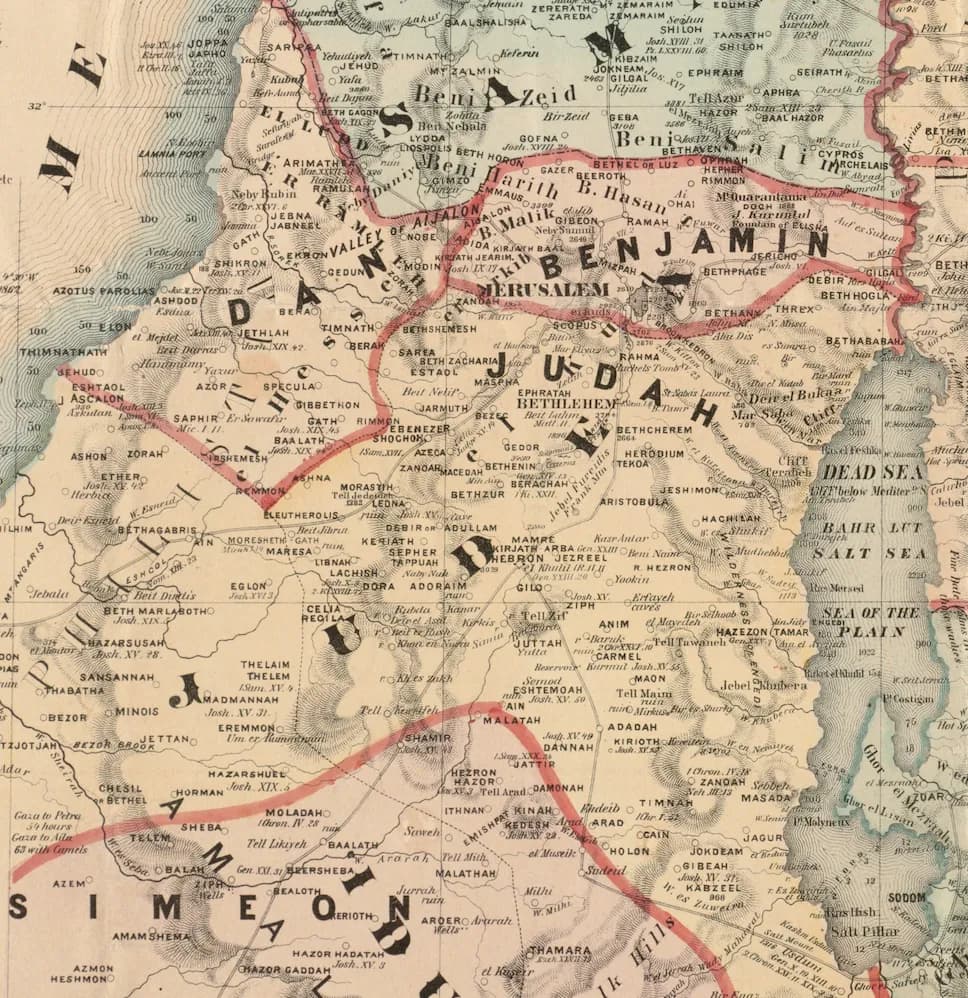
Ain was a city initially assigned to the tribe of Judah on its southern border, but afterward allotted to Simeon and designated as a Levitical city. It is consistently mentioned alongside Rimmon, and may be identical with En-rimmon of the post-exilic period. The city has been tentatively identified with the modern village el-Ghuwein south of Hebron, though this remains uncertain.
☩Northern Boundary Landmark
A second Ain is mentioned as a landmark on the northern or eastern boundary of Palestine near the Sea of Galilee, adjoining Riblah. This may refer to the modern Ain in Coele-Syria between the Orontes and the Litany rivers, marked by a large fountain strong enough to drive several mills. Jerome identified it with the famous spring in the grove of Daphne at Antioch.
Related Verses6 mentions
See Also
References
- 1.John McClintock and James Strong, "Ain," in Cyclopedia of Biblical, Theological and Ecclesiastical Literature, vol. I (Harper & Brothers, 1867–1887).
- 2.George Morrish, "Ain," in Morrish's Concise Bible Dictionary (George Morrish, 1898).
- 3.Andrew Robert Fausset, "Ain," in The Englishman's Critical and Expository Bible Cyclopædia (Hodder & Stoughton, 1878).