
Accho
“Possibly from an Arabic root meaning 'to be hot,' referring to the sultry sands”
Summary
An ancient harbor city on the Mediterranean coast, later known as Ptolemais and Acre, which served as a strategic gateway to Palestine throughout biblical history.
☩Location and Importance
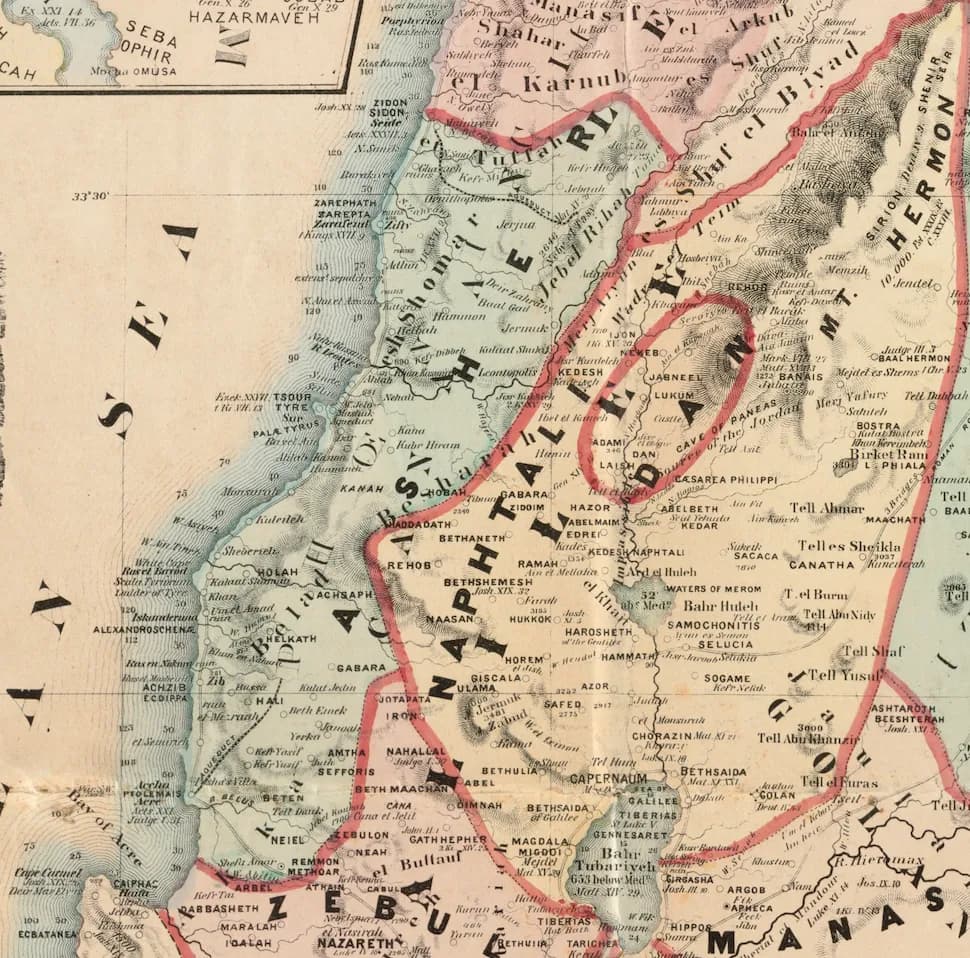
Accho occupied the northwestern point of a bay opposite Mount Carmel, on a remarkably fertile plain about six miles wide. Its strategic position controlling both sea and land approaches from the north earned it the title 'key of Palestine.' The small river Belus flowed nearby, its sands used by the Phoenicians for making glass.
☩Israelite Period
Though assigned to the tribe of Asher, Accho remained unconquered by Israel. The Canaanite inhabitants continued to dwell there, representing one of the territories Israel failed to possess. This failure would prove significant in Israel's later history.
☩Later Names
The city received the name Ptolemais from Ptolemy I of Egypt, who greatly improved it. Under Emperor Claudius it became a Roman colony. During the Crusades it was known as Acre or St. Jean d'Acre from the Knights of St. John. Despite these changes, it retained variations of its ancient name Accho or Akka.
See Also
References
- 1.John McClintock and James Strong, "Accho," in Cyclopedia of Biblical, Theological and Ecclesiastical Literature, vol. I (Harper & Brothers, 1867–1887).
- 2.George Morrish, "Accho," in Morrish's Concise Bible Dictionary (George Morrish, 1898).
- 3.F. N. Peloubet & M. A. Peloubet (ed.), "Accho," in Smith's Bible Dictionary (Porter & Coates, 1884).
- 4.Andrew Robert Fausset, "Accho," in The Englishman's Critical and Expository Bible Cyclopædia (Hodder & Stoughton, 1878).