
Hamor
“A he-ass or male donkey”
Summary
Hamor was a Hivite prince of Shechem from whom Jacob purchased land, and whose son Shechem defiled Dinah, leading to the massacre of the city by her brothers.
☩Prince of Shechem
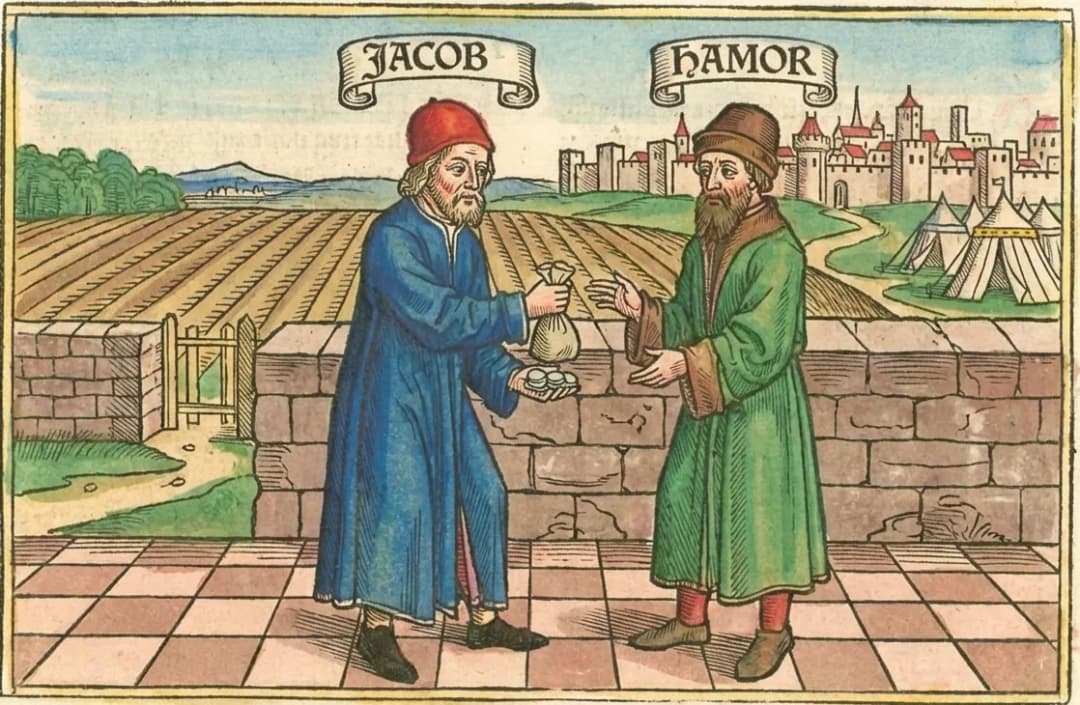
Hamor was a Hivite prince who ruled the land and city of Shechem at the time Jacob entered Canaan. His name means "he-ass" (donkeys being prized animals in that culture). Jacob purchased a parcel of land from him or his sons for 100 kesita (bars or rings of silver), which became Joseph's burial place centuries later. In Acts 7:16, his name appears in the Greek form Emmor.
☩The Tragedy at Shechem
Hamor's son Shechem violated Dinah, Jacob's daughter, then sought to marry her. Hamor behaved with diplomatic tact, proposing intermarriage between the two peoples and offering generous terms. However, Simeon and Levi treacherously required the Shechemites to be circumcised as a condition, then attacked when they were incapacitated, killing Hamor, Shechem, and all the males of the city. Jacob condemned this act of vengeance on his deathbed.
☩Later References
Centuries later, during Abimelech's time, the Shechemites invoked "the men of Hamor" as a rallying cry for revolt against Israelite rule, indicating the lasting resentment from the earlier massacre. The land Jacob purchased from Hamor retained significance as Joseph's final resting place, mentioned by Stephen in his speech before the Sanhedrin.
Related Verses12 mentions
See Also
References
- 1.John McClintock and James Strong, "Hamor," in Cyclopedia of Biblical, Theological and Ecclesiastical Literature, vol. IV (Harper & Brothers, 1867–1887).
- 2.George Morrish, "Hamor," in Morrish's Concise Bible Dictionary (George Morrish, 1898).
- 3.F. N. Peloubet & M. A. Peloubet (ed.), "Hamor," in Smith's Bible Dictionary (Porter & Coates, 1884).
- 4.Andrew Robert Fausset, "Hamor," in The Englishman's Critical and Expository Bible Cyclopædia (Hodder & Stoughton, 1878).