
Viol
“A stringed instrument (also means leather bottle)”
Summary
The viol in the Authorized Version translates the Hebrew nebel, a stringed musical instrument elsewhere rendered 'psaltery,' used in worship and at festive occasions.
☩The Hebrew Nebel
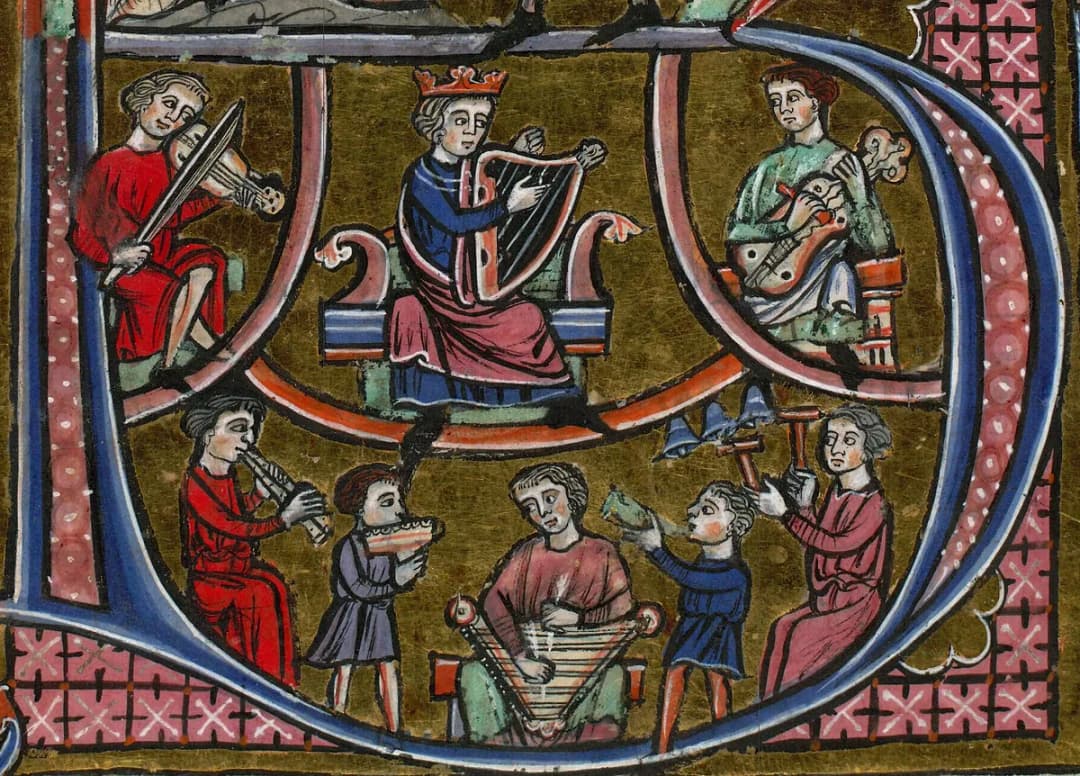
The word 'viol' renders the Hebrew nebel at Amos 5:23 and 6:5, while the same word is elsewhere translated 'psaltery.' It was a stringed instrument used chiefly in worship but also at worldly festivals and banquets. According to Josephus, it had twelve strings and was played by hand. However, the expression 'nebel asor' (instrument of ten strings) in Psalm 33:2 and 144:9 suggests the number may have varied. The instrument passed from the East to the Greeks, who retained the name nabla.
☩Form and Character
The original form of the nebel is uncertain. Augustine suggested that the psaltery (nablium) differed from the cithara in having the sounding-box on the upper side, resembling an inverted delta (Δ) and enlarging upwards. Such instruments appear on Egyptian monuments. It was not a proper harp but more like the cithara, and was often connected with the kinnor (harp). The old English viol, by contrast, was a six-stringed guitar with frets marking finger positions, coming in various sizes for treble, mean, counter-tenor, tenor, and bass.
See Also
References
- 1.John McClintock and James Strong, "Viol," in Cyclopedia of Biblical, Theological and Ecclesiastical Literature, vol. X (Harper & Brothers, 1867–1887).
- 2.James Orr (ed.), "Viol," in International Standard Bible Encyclopedia, vol. V (Howard-Severance Company, 1915).
- 3.George Morrish, "Viol," in Morrish's Concise Bible Dictionary (George Morrish, 1898).